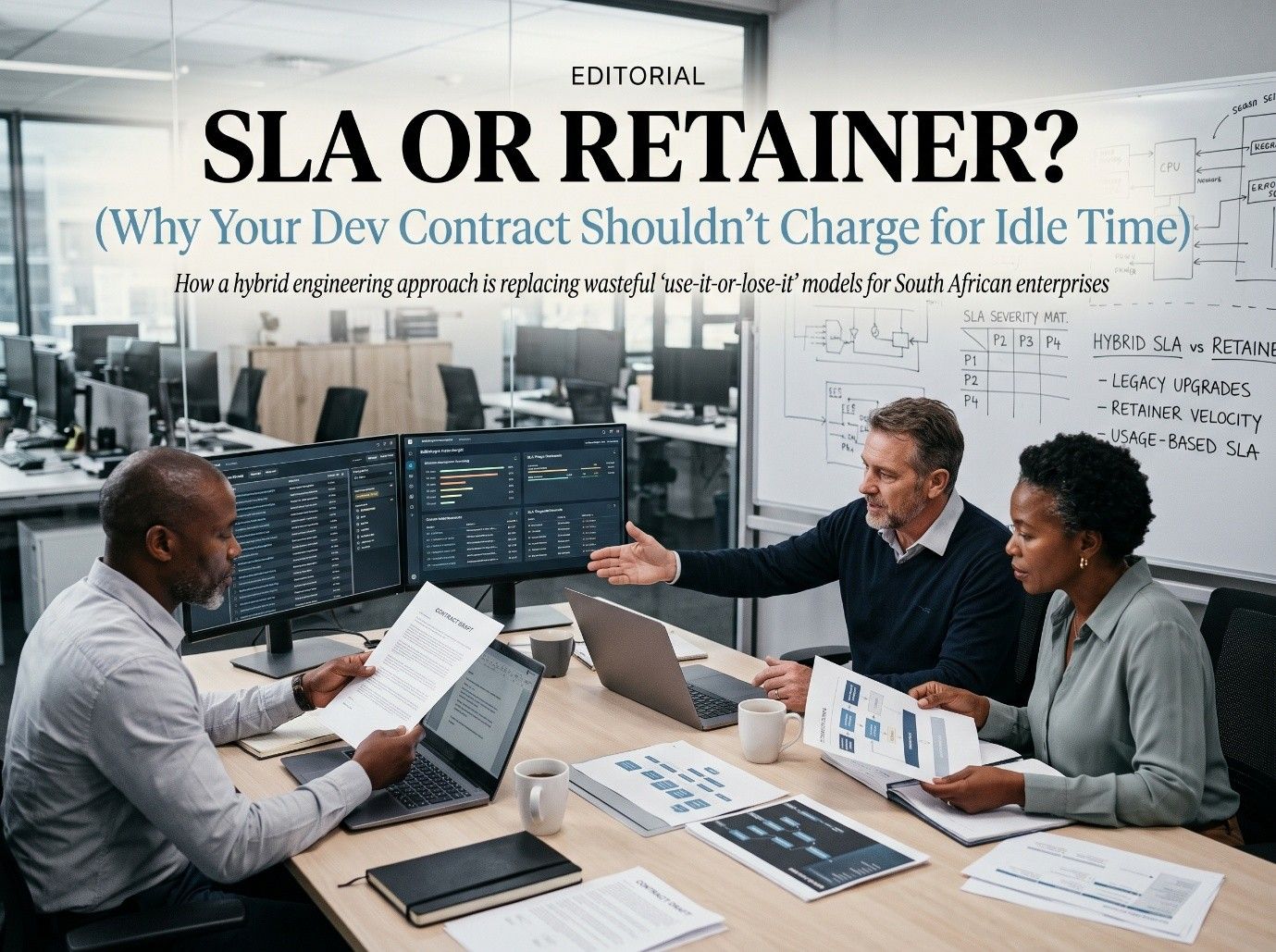
The “Expired Hours” Tax: Why We Replaced One-Size-Fits-All Agency Retainers With a Hybrid Engineering Model
If you look closely at the Master Services Agreements (MSAs) signed across Sandton, Rosebank, and Century City, you will notice a quiet commercial contradiction.
A corporate or SME client pays an agency hundreds of thousands—sometimes millions—of Rands to architect a rock-solid software platform or modernize a legacy system. The goal of good engineering is stability: clean code, automated data pipelines, and zero operational friction.
Then, the day the system goes live, the agency hands the client a mandatory Fixed Monthly Retainer: “Pay us for 40 hours every month, whether you use them or not. Unused hours expire on the 30th.”
Think about the incentive structure of that deal for a moment.
If the agency did their job properly and engineered a stable platform, the system shouldn’t break for 40 hours every month. Yet under the traditional metropolitan agency model, the client is financially penalized for having stable software.
At Digital Platforms, after 18 years of building, automating, and maintaining both massive enterprise architectures and agile business systems across South Africa, we took a hard look at this model—and threw the one-size-fits-all playbook out the window.
Instead, we operate on a Dual-Track Hybrid Model: Usage-Based SLAs for the majority of our clients, and Hands-On Velocity Retainers strictly for clients who require daily development execution.
Here is why matching your contract structure to your software’s actual lifecycle is the smartest move for South African businesses right now.
The Problem With the Metropolitan “Use-It-or-Lose-It” Obsession
Why do so many development houses in Johannesburg and Cape Town refuse to support a system unless you sign a heavy monthly hour-block retainer?
The answer has nothing to do with your codebase, and everything to do with agency overhead.
When a consultancy is carrying prime metropolitan real estate, bloated middle-management layers (account executives, traffic managers, junior scrum coordinators), and a high-churn bench of junior developers, they have a massive fixed monthly burn. To survive, they treat every maintenance client as a subsidized revenue stream. They rely on “hour breakage”—the quiet months where you pay for 35 hours of developer time, use 3 hours, and forfeit the remaining 32 hours back to the agency’s bottom line.
That creates two toxic outcomes:
- The “Ghost Invoice” Resentment: By month four of a quiet cycle, your CFO looks at the P&L and asks why the business is paying tens of thousands of Rands for nothing.
- The “Make-Work” Spiral: Around the 22nd of the month, either the client invents low-priority cosmetic tasks just so their pre-paid hours don’t vanish, or the agency pads minor 2-hour fixes into 10-hour logging exercises to make the retainer look “active.”
Neither of those builds better software.
Track 1: The Usage-Based SLA (For Stable & Mission-Critical Systems)
In South African technology law, a Service Level Agreement (SLA) is not supposed to be a prepaid bucket of hours. An SLA is a governance and reliability guarantee.
For the majority of our clients—whether they are running a modernized enterprise ERP integration, an automated logistics portal, or a mid-sized commercial platform—their system does not need a developer tinkering with it eight hours a day. They need insurance, accountability, and speed when it matters.
Under our Usage-Based SLA model:
- You Get Ironclad Response Guarantees: We lock in strict, legally binding response windows (including sub-30-minute triage for critical P1 incidents), POPIA data compliance, and system ownership.
- You Only Pay for the Hours You Actually Use: If your system runs flawlessly in March and you only log 2 hours of minor updates or API tweaks, you are billed for 2 hours. Not 40.
- Zero Expired Hours: Not a single Rand of your IT budget evaporates at midnight on the 30th.
Why can we offer this when big-city agencies won’t? Because our Bloemfontein engineering hub operates without Sandton’s real-estate bloat, and our 100% senior engineering team writes clean, automated code that doesn’t require babysitting.
Track 2: The Dedicated Retainer (When You Need Daily Hands-On Velocity)
Does this mean retainers are dead? Not at all—when they are used for what they were actually designed for.
Some of our clients are in aggressive growth, active legacy migration, or continuous product expansion phases. They aren’t looking for standby maintenance; they require daily, hands-on engineering execution:
- Shipping new features every sprint.
- Unwinding complex legacy monoliths phase-by-phase and automating manual workflows.
- Continuous daily collaboration with internal product owners, rolling out new modules, UI enhancements, or third-party integrations.
For these clients, our Dedicated Retainer is the ultimate accelerator. Instead of going through the costly, 6-month headache of recruiting, onboarding, and managing full-time in-house developers (plus payroll taxes, benefits, and key-person risk), they lock in dedicated monthly capacity from our senior engineering squad at a structured rate.
Because they have a daily queue of development tasks, every single retained hour is put to work building business value.
Side-by-Side: Why the Hybrid Model Wins for Large & Small Systems
The beauty of this dual approach is that it serves a mid-sized regional business and a multi-division corporate enterprise equally well—and allows a client to shift gears as their business evolves:
| Dimension | Metro “One-Size-Fits-All” Retainer | Digital Platforms: Usage-Based SLA | Digital Platforms: Hands-On Retainer |
| Best Suited For | Protecting the agency’s monthly cash flow | Live systems needing guaranteed uptime, ad-hoc enhancements & support | Active roadmaps, daily tasks, continuous feature builds & legacy upgrades |
| Billing Structure | Fixed monthly block; unused hours expire | Pay strictly for actual hours worked | Reserved monthly capacity at preferential rates |
| SLA Response Guarantee | Bundled into expensive monthly minimums | Full P1–P4 SLA protection included | Priority daily access & dedicated sprint velocity |
| Quiet Month Impact | Client loses money on unused hours | Client pays only for what was used | N/A — built for clients with continuous daily backlogs |
| Engineering Tier | Often delegated to juniors to protect margin | Direct access to Senior Engineers | Embedded Senior Architects & Product Devs |
The Freedom to Scale Up—or Down—Without Penalty
Software isn’t static. A company might spend six months on a Hands-On Retainer with us while we modernize their legacy database, automate their field-to-office workflows, and launch a new customer portal.
Once that heavy lifting is complete and the system is humming, a traditional metropolitan agency tries to trap them in that same high monthly retainer forever.
At Digital Platforms, we simply transition them onto our Usage-Based SLA. They keep the exact same senior engineering team who built the system, the same institutional backing of Central Media Group and African Media Entertainment (AME), and the same rapid response guarantees—while dropping their monthly spend down to only the exact hours they use.
That is how you build 18-year client relationships. Not by locking businesses into “use-it-or-lose-it” contracts, but by giving them the right engineering model at the right time, at a structurally smarter cost.
Are you currently paying a monthly agency retainer for hours that expire on the 30th—or struggling to get daily velocity on a legacy system that needs hands-on modernization? Let’s talk. Reach out to the team at Digital Platforms to structure an SLA or development partnership that actually fits how your business runs.
#SoftwareEngineering #SLAAgreements #ITProcurement #LegacyModernization #TechLeadership #SouthAfricaBusiness #DigitalPlatforms #CentralMediaGroup #AME #Bloemfontein