From Glovebox Chaos to Cloud Precision: How Digital Platforms Built a Fleet System That Runs Itself
By Digital Platforms
Anyone who has ever managed a company fleet knows the familiar dread: a crumpled fuel receipt wedged behind the passenger visor, two teams mistakenly claiming the same bakkie for an afternoon job, and a maintenance schedule maintained only by memory and good fortune.
That was the reality for a Digital Platforms client — a growing South African operation running a mixed fleet across multiple branches, with trip bookings handled on paper, fuel slips recovered by chasing drivers at month-end, and vehicle inspections tracked in a notebook nobody quite trusted.
Something had to change. So Digital Platforms wrote them a system.
The Problem: Every Fleet Tells the Same Story
The client’s challenges were refreshingly universal. Bookings arrived by phone, WhatsApp and word of mouth — often colliding. Odometer readings were remembered, or weren’t. Fuel and toll costs surfaced weeks later, if at all. Compliance documents expired quietly in a drawer. And when management asked the simple question, “Which vehicles are actually free this afternoon?”, nobody could answer it quickly.
“Most fleets we speak to aren’t badly run,” says the Digital Platforms team. “They’re just running on tools that were never built for them. Spreadsheets and goodwill only stretch so far.”
The Solution: One System, Two Experiences
What Digital Platforms delivered is a single platform that behaves very differently depending on who opens it.
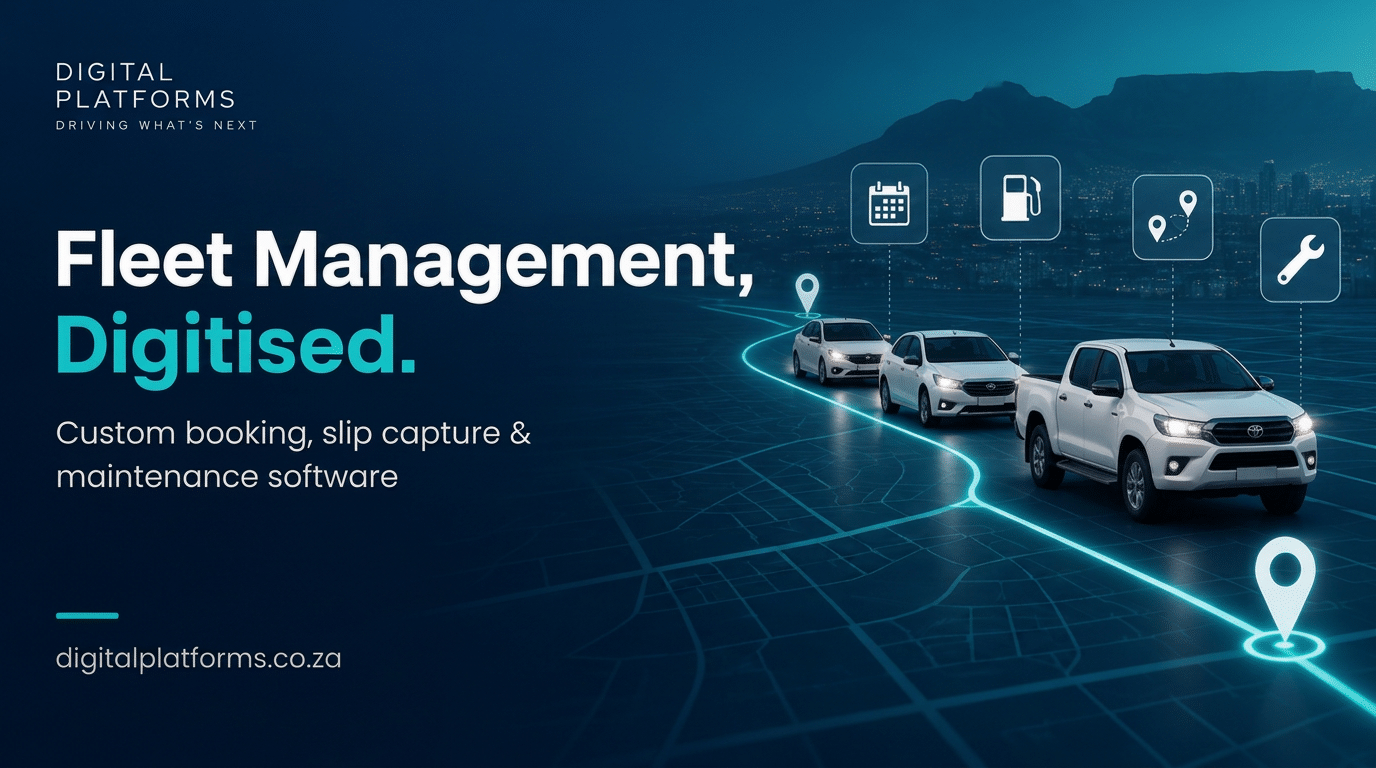
For drivers and staff, it lives on the phone as an installable web app — no app store, no download queue. Booking a vehicle takes seconds, with locations pre-filled and a calendar that shows real availability. A trip can’t be submitted without the odometer, and the moment fuel or toll is spent, the driver photographs the slip. The system reads the slip itself — extracting the amount, litres and date automatically — so nobody has to retype a receipt at midnight.
For administrators, it becomes a control room. A week-at-a-glance calendar shows every trip in progress, booked and completed, colour-coded, with daily vehicle availability right on top. Click a free vehicle and a booking is already half-filled. Click a trip block and the full record — kilometres, drivers, client, reason, status — opens in place. Approvals, overrides, inspection schedules and reports all sit one click away.
The Details That Make It Work
A few of the touches Digital Platforms built for this client say a lot about the thinking behind the system:
- Vehicle swaps that hold up under scrutiny. Two drivers swap vehicles mid-event? They agree between themselves, and the system splits the trip into two legs — first driver’s start and end kilometres, second driver’s start and end kilometres. No admin approval needed, but nothing disappears from the audit trail.
- Handing over the wheel. If a passenger takes over the drive home, the driver logs it themselves. Reports then show exactly who drove out and who drove back — a compliance detail most systems simply never capture.
- Availability that understands time. Before a booking is confirmed, the system checks the clock. A vehicle currently out gets flagged. One due back within minutes of a new departure gets a clear warning: technically bookable, practically tight.
- Inspections on a schedule, not a hope. Vehicles that need weekly checks are flagged automatically, inspected against a template administrators can edit, and every result is stored on the vehicle profile — exportable for reporting in CSV or PDF.
- Indemnity handled before the wheels turn. When a passenger isn’t staff, the system requires an indemnity form — with the official template one download away — before the request goes through.
- Alerts that arrive, not emails that get lost. Push notifications reach drivers when a trip is approved and again before departure. Admins are looped in when something changes.
The Result
For the client, the change is measured in hours rather than features. Slip recovery is no longer a month-end investigation. Double bookings have effectively stopped. Maintenance and compliance no longer rely on someone remembering. And the question every fleet manager fears — “what’s available right now?” — now has an answer in under a second.
“Digital Platforms didn’t sell us a package,” the client notes. “They watched how we actually work, and then built software that fits.”
That, arguably, is the entire argument for custom software: off-the-shelf tools ask you to change your habits. Good software changes nothing but the friction.
Thinking about your own operational bottleneck?
Digital Platforms designs and builds custom web and mobile systems for South African businesses — fleet, logistics, booking, compliance and back-office workflows included. If spreadsheets, WhatsApp threads and memory are holding your operation together, it’s worth a conversation.
📩 Email: info@digitalplatforms.co.za 🌐 Web: digitalplatforms.co.za
#FleetManagement #CustomSoftware #DigitalTransformation #SoftwareEngineering #Automation #DigitalPlatforms #PWA