The Big 5 in AI: Who’s Leading the Revolution?
The Big 5 in AI: Who’s Leading the Revolution?
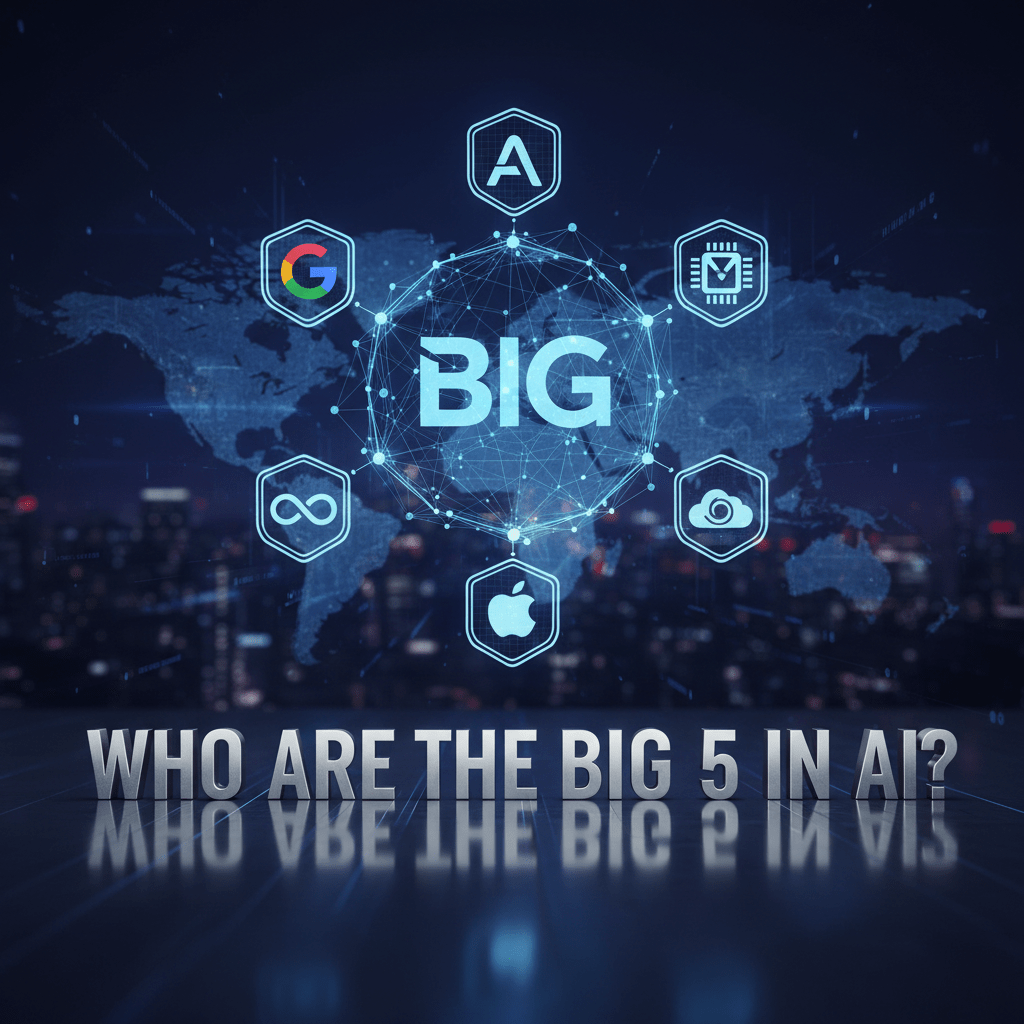
Ever wondered who’s truly at the helm of the artificial intelligence revolution? It’s a question that pops up a lot, especially as AI permeates almost every aspect of our lives. We’re talking about the titans, the innovators, the companies pouring billions into R&D to shape our technological future. Identifying The Big 5 in AI isn’t just about market cap; it’s about influence, innovation, and the sheer scale of their impact.
These companies aren’t just dabbling in AI; they’re making it the cornerstone of their strategies, driving advancements that were once pure science fiction. From powering our everyday searches to developing complex autonomous systems, their fingerprints are everywhere. Let’s peel back the layers and discover who these formidable players truly are.
Ready to meet the giants?
Table of Contents
- Understanding The Big 5 in AI
- Google (Alphabet): The Search Giant and AI Pioneer
- Microsoft: Powering the Enterprise and Beyond
- Amazon: AI for E-commerce and Cloud
- Apple: Privacy-Centric AI on Your Devices
- Meta (formerly Facebook): Connecting the World with AI
- The Impact and Future of The Big 5 in AI
- FAQ about The Big 5 in AI
- Conclusion: The Ever-Evolving Landscape of AI Leadership
Understanding The Big 5 in AI
When we talk about The Big 5 in AI, we’re not just throwing around names arbitrarily. We’re pinpointing companies that hold immense sway over the direction, development, and application of artificial intelligence globally. Think of them as the orchestrators of our digital symphony, each playing a crucial, loud instrument.
What makes a company part of this elite group? It’s usually a combination of massive investments in AI research, acquiring top talent, integrating AI deeply into their core products, and holding significant market share in related fields. These aren’t just tech companies; they are AI-first companies.
Criteria for Inclusion
It’s not enough to simply use AI; these companies are building the foundational blocks. Our criteria for categorizing the big 5 in AI include:
- R&D Investment: Billions poured into advanced AI research annually.
- Talent Acquisition: Snapping up the brightest minds and leading AI researchers.
- Product Integration: AI isn’t an add-on; it’s central to their offerings.
- Ecosystem Influence: Creating platforms and tools that others build upon.
- Market Dominance: Significant presence in adjacent markets like cloud, search, and social media, which fuel their AI capabilities.
They truly set the pace, don’t they? And this domination has profound implications for how AI evolves and touches our lives.
Google (Alphabet): The Search Giant and AI Pioneer
It’s almost impossible to talk about AI without mentioning Google. For many, Google was one of the first companies to bring AI to the masses through search algorithms and recommendation engines. Their parent company, Alphabet, is arguably the most dominant force within The Big 5 in AI.
From deep learning breakthroughs at DeepMind to the ubiquitous Google Assistant and the power of TensorFlow, their open-source machine learning library, Google’s influence is pervasive. They’re not just interpreting data; they’re predicting, understanding, and creating new paradigms for interaction.
Key AI Initiatives and Products
- DeepMind: Acquired by Google in 2014, this UK-based AI research lab is behind AlphaGo, AlphaFold, and countless other scientific breakthroughs.
- Google Assistant: Your voice-activated helper, constantly improving its understanding and capabilities.
- TensorFlow: An open-source machine learning framework that is widely used by developers and researchers globally.
- Cloud AI: Offering a suite of AI services to businesses, from machine learning APIs to custom model training.
Google’s commitment to AI is clear, evidenced by their “AI-first” mantra. They leverage their vast quantities of data to train ever more sophisticated models, continually pushing the boundaries of what AI can achieve. Their research papers are industry benchmarks, and their innovations set the trend.
Microsoft: Powering the Enterprise and Beyond
While Google might be seen as the consumer AI giant, Microsoft has established itself as an indispensable partner for enterprises leveraging AI. They’ve made incredible strides, especially with their investment in OpenAI and the integration of AI across their entire product suite.
From Azure AI services to Copilot in Microsoft 365, they’re embedding intelligence into everything from spreadsheets to operating systems. Their strategy focuses on making AI accessible and powerful for businesses of all sizes.
Microsoft’s AI Ecosystem
- Azure AI: A comprehensive set of cloud-based AI services, including machine learning, cognitive services, and AI infrastructure.
- OpenAI Partnership: A multi-billion dollar investment and exclusive cloud provider for one of the most talked-about AI research labs, bringing ChatGPT and DALL-E to the forefront.
- Copilot: AI assistants integrated into Microsoft 365 applications, Windows, and GitHub, aiming to boost productivity dramatically.
- Xbox AI: Using AI for game development, player matching, and personalized experiences.
Microsoft’s approach is often described as “democratizing AI,” providing powerful tools and platforms that enable others to build and innovate. They’re a key enabler for many businesses looking to integrate intelligent solutions, and their influence on the big 5 in AI is arguably one of the most profound for the business world.
Amazon: AI for E-commerce and Cloud
Amazon’s AI story begins long before Alexa. Their recommendation engines, fraud detection systems, and logistics optimization have been powered by AI for decades, making them an unsung hero within The Big 5 in AI long before the term was widely used.
Today, their AI presence is massive, primarily through Amazon Web Services (AWS) and their consumer-facing products. AWS provides the backbone for countless AI startups and enterprises, offering powerful machine learning services without the need for massive infrastructure investments.
AI Innovations at Amazon
- Alexa: The highly popular voice assistant, now integrated into a wide array of devices.
- AWS AI Services: A broad portfolio of services, including SageMaker for machine learning development, Rekognition for image and video analysis, and Polly for text-to-speech.
- Recommendation Engines: The secret sauce behind Amazon’s personalized shopping experience, suggesting products you didn’t even know you needed.
- Logistics and Robotics: AI-powered systems optimizing warehouse operations and delivery routes, making their supply chain incredibly efficient.
Amazon doesn’t just sell products; they sell infrastructure and intelligence. Their ability to leverage massive datasets from e-commerce and cloud operations gives them a unique feedback loop, continually refining their AI models. It’s a prime example of how data fuels AI growth.
Apple: Privacy-Centric AI on Your Devices
Apple’s approach to AI often differs from the other giants, with a strong emphasis on privacy and on-device processing. While they might not be as vocal about their raw AI advancements, their products are deeply infused with intelligent features.
Siri, Face ID, computational photography, and personalized health features all rely on sophisticated AI and machine learning. Their focus is often on enhancing the user experience directly on their devices, minimizing data transfer to the cloud where possible.
Apple’s Unique AI Stance
- Siri: A pioneering voice assistant that has seen continuous improvement in natural language understanding and contextual awareness.
- Neural Engine: Dedicated hardware in their chips (A-series, M-series) designed for accelerating machine learning tasks directly on the device.
- Computational Photography: AI algorithms enhance image quality, enable Portrait Mode, and improve low-light performance.
- Privacy-Preserving AI: A strong commitment to processing as much data as possible on-device, prioritizing user privacy.
Apple’s unique stance on privacy often means their AI is developed with different constraints, making their innovations particularly interesting. They demonstrate that powerful AI doesn’t always have to come at the expense of user data, positioning them distinctly within The Big 5 in AI.
Meta (formerly Facebook): Connecting the World with AI
Meta, formerly Facebook, has been a quiet powerhouse in AI research for years, even before its pivot to the metaverse. Their AI is fundamental to their core platforms, Facebook, Instagram, and WhatsApp, driving content recommendations, moderation, and advertising.
Their FAIR (Facebook AI Research) lab is a leading contributor to open-source AI, including PyTorch, a popular deep learning framework. Now, with the metaverse vision, AI is set to play an even more critical role in building immersive virtual worlds.
Meta’s AI Contributions
- Content Ranking and Recommendations: AI algorithms decide what you see in your feed, tailoring content to your interests.
- Computer Vision: Powering features like automatic photo tagging, object recognition, and augmented reality filters.
- Natural Language Processing: Used for understanding posts, translating languages, and improving communication.
- PyTorch: An open-source machine learning library that has become a favorite among researchers and developers.
- Metaverse Development: AI is crucial for building believable avatars, dynamic virtual environments, and intuitive human-computer interfaces within the metaverse.
Meta’s investment in AI is substantial, not just for their current social platforms but for their ambitious future plans. Their commitment to open-source initiatives also allows wider adoption and collaboration within the AI community, cementing their place among The Big 5 in AI.
For businesses looking to leverage cutting-edge AI for their platforms, services like those offered by Digital Platforms can be incredibly valuable. Our expertise in AI system development helps companies navigate the complexities of integrating these powerful technologies, ensuring efficient and impactful results.
The Impact and Future of The Big 5 in AI
The collective impact of these five tech giants on the field of AI is simply staggering. They’re not just developing products; they’re setting research agendas, influencing policy, and attracting the vast majority of top AI talent. What does this mean for the future?
Well, for starters, expect more unprecedented advancements. We’re talking about AI that understands context better, generates more realistic content, and interacts with us in increasingly natural ways. The speed of innovation is only accelerating, pushing us into uncharted territories.
Trends Driven by These Giants
- Responsible AI: With great power comes great responsibility, and these companies are increasingly focusing on ethical AI development and governance. Have we truly considered all the implications?
- Generative AI: From text to images to code, AI’s ability to create new content is exploding, driven by models developed by these players and their partners.
- AI Acceleration Hardware: Beyond software, they are investing heavily in specialized chips (like Google’s TPUs and Apple’s Neural Engine) to make AI faster and more efficient.
- Ubiquitous AI: AI will continue to be embedded everywhere, from smart homes and cars to healthcare and industry.
However, their dominance also raises questions about competition, data privacy, and the concentration of power. Ensuring a diverse and ethical AI ecosystem is a challenge that concerns us all.
Navigating this complex landscape requires both vision and technical prowess. That’s where professional services, like the custom AI solutions Digital Platforms offers, become critical. Our team has a proven track record of helping businesses harness these powerful technologies responsibly, focusing on cutting-edge AI development services that deliver real-world value.
FAQ about The Big 5 in AI
What defines a “Big 5” company in AI?
A ‘Big 5’ company in AI stands out due to its significant market capitalization, extensive research and development investments, widespread product integration, talent acquisition, and overall influence on the AI landscape. They aren’t just making AI; they’re shaping its future.
How are these AI giants impacting daily life?
These AI giants are impacting daily life through countless applications: powering your smartphone’s voice assistant, recommending products you might like, enhancing search engine results, improving navigation, and even developing critical healthcare solutions. Their influence is woven into the fabric of our modern digital experience.
Can smaller companies compete with the Big 5 in AI?
While the scale of the Big 5 in AI is immense, smaller companies and startups can absolutely compete by focusing on niche markets, specialized AI solutions, and innovative applications that the larger giants may overlook. Agility and focused expertise can be powerful advantages, often leading to acquisitions by larger players.
Conclusion: The Ever-Evolving Landscape of AI Leadership
So, there you have it – a closer look at The Big 5 in AI: Google, Microsoft, Amazon, Apple, and Meta. These companies are not just participants in the AI revolution; they are its primary architects, continually pushing the boundaries of what’s possible.
Their unique strategies, from Google’s research-first approach to Apple’s privacy-centric on-device intelligence, showcase the diverse ways AI is being developed and deployed. The future of AI will undoubtedly continue to be shaped by their innovations, investments, and ethical considerations.
As AI continues to evolve at breakneck speed, understanding these key players helps us make sense of the technological shifts around us. What exciting new developments will they bring to the table next?
For information or free consultation, visit our services pages and send us an email: www.digitalplatforms.co.za.