Jobs Safe From AI: Human Skills That Endure
Jobs Safe From AI: Human Skills That Endure
The dawn of artificial intelligence has sparked a whirlwind of excitement and, let’s be honest, a fair bit of anxiety. We’re constantly hearing about AI’s incredible capabilities, from writing compelling prose to diagnosing complex medical conditions. This progress naturally leads to a big question: what about our jobs? Are our careers on a collision course with automation? While it’s true that AI will undoubtedly reshape the workforce, there are specific jobs safe from AI – roles deeply rooted in human unique capabilities that machines simply can’t replicate. Let’s delve into the roles that are likely to stand the test of time, proving that the human touch remains irreplaceable.
Table of Contents
- Understanding AI’s Limitations: Why Some Jobs Are Safe From AI
- The Creative Maestros: Jobs Ignited by Imagination
- The Empathy Engineers: Roles Requiring Deep Human Connection
- The Strategic Navigators: Jobs Demanding Complex Problem-Solving
- Preparing for the Future: Skills to Thrive in an AI World
- Frequently Asked Questions About Jobs Safe from AI
- Conclusion
Understanding AI’s Limitations: Why Some Jobs Are Safe From AI
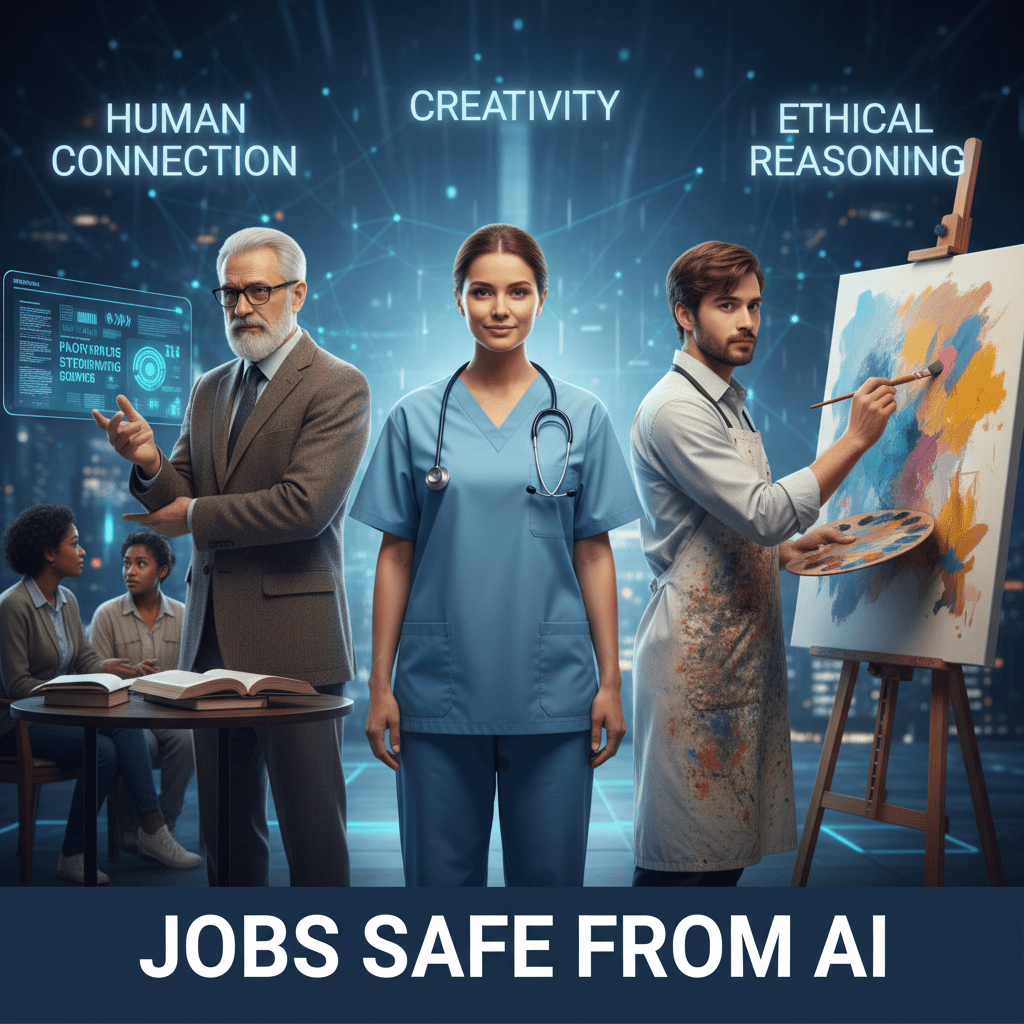
Before we pinpoint the careers that are set to endure, it’s crucial to grasp what AI truly excels at and, more importantly, where its current limitations lie. AI thrives on data, patterns, and logic. It can process information at speeds unimaginable to humans and execute repetitive tasks with incredible precision. However, it struggles mightily with genuine creativity, nuanced emotional understanding, and abstract, ethical reasoning.
AI’s Strengths: Repetition and Data Processing
Think about tasks that involve large datasets, pattern recognition, or formulaic execution. These are AI’s playgrounds. From financial trading algorithms to customer service chatbots handling routine inquiries, AI can boost efficiency like never before. It excels at optimizing processes and making predictions based on historical data.
However, simply optimizing isn’t enough when innovation is needed. That’s where human ingenuity steps in, shaping the very problems AI is meant to solve.
AI’s Weaknesses: The Human Element
This is where the magic happens for jobs safe from AI. Machines lack consciousness, self-awareness, and genuine intuition. They don’t experience emotions, grapple with moral dilemmas in the same way we do, or understand the subtle complexities of human relationships spontaneously. Can an algorithm truly inspire a team or comfort a grieving family? Not yet, and perhaps never.
Moreover, AI’s “creativity” is largely generative, based on extrapolating from existing data, not genuinely inventing from a blank slate of conceptual understanding. It’s like remixing existing songs, not composing an entirely new genre from scratch.
The Creative Maestros: Jobs Ignited by Imagination
When we talk about jobs safe from AI, the creative sector immediately springs to mind. Creativity isn’t just about painting a picture or writing a novel; it’s about connecting disparate ideas, envisioning new possibilities, and crafting narratives that resonate with the human experience. These are areas where AI can assist but not lead.
Artists, Designers, and Content Creators
While AI can generate images, write short stories, or even compose music, it lacks the lived experiences, emotional depth, and unique perspectives that truly define human artistry. A human artist imbues their work with personal meaning, cultural context, and a soul that an algorithm simply can’t replicate.
- Visual Artists & Designers: From graphic designers creating brand identities that evoke specific feelings, to fine artists exploring abstract concepts, these roles demand an understanding of aesthetics, human psychology, and cultural trends that goes beyond data points.
- Writers & Storytellers: AI can churn out articles, but can it craft a deeply moving novel, a captivating screenplay, or a persuasive marketing campaign that truly understands the human desire? The nuanced use of language, irony, and metaphor to convey complex emotions remains a human stronghold.
- Musicians & Composers: While AI can generate melodies, the emotional arc, cultural influence, and improvisational brilliance of a human musician or composer is unparalleled. Think of a jazz improvisation – it’s a real-time creative act responding to complex human interplay.
These roles require not just skill, but also a unique voice and an ability to connect with an audience on a deeply human level. Digital Platforms, understanding this critical intersection of technology and creativity, often works with agencies and content creators, providing back-end web development and custom software solutions that empower these human-centric creative roles, rather than replacing them.
The Empathy Engineers: Roles Requiring Deep Human Connection
Perhaps the most inherently human aspect of our existence is our capacity for empathy – to understand and share the feelings of another. AI can process inputs and provide relevant information, but it cannot genuinely empathize, comfort, or build trust in the way a human can. This makes roles centered around deep human interaction undoubtedly jobs safe from AI.
Healthcare Professionals & Therapists
Consider the delicate balance of diagnosis, treatment, and emotional support required in healthcare. While AI can assist doctors in analyzing scans or predicting disease progression, the compassionate delivery of bad news, the nuanced understanding of a patient’s fears, or the therapeutic relationship built over time are profoundly human.
- Doctors & Nurses: Beyond technical skill, these professionals offer comfort, reassurance, and emotional support. A machine can’t hold a patient’s hand or truly understand the anxiety they feel.
- Psychologists & Therapists: These roles are fundamentally about understanding the intricate landscape of the human psyche, building rapport, and guiding individuals through emotional challenges. Empathy, intuition, and non-verbal cues are paramount.
According to a report by the World Economic Forum on Future of Jobs, human-centric roles like caregiving and emotional support are projected to see significant growth, underscoring their AI-proof nature.
Educators & Mentors
Teaching is far more than just delivering information. It involves inspiring curiosity, adapting to individual learning styles, and fostering critical thinking. A great teacher doesn’t just impart facts; they shape minds and futures. Mentorship is even more personal, guiding individuals through professional and personal growth with tailored advice and encouragement.
An AI could tutor, yes, but it can’t spark a passion, recognize a student’s unspoken struggle, or act as a true role model. The dynamic classroom experience, the impromptu discussion, the personalized encouragement – these are human-driven triumphs.
The Strategic Navigators: Jobs Demanding Complex Problem-Solving
While AI can optimize strategies based on existing data, it struggles with genuinely innovative, complex problem-solving that requires abstract thought, ethical considerations, and an understanding of unforeseen variables. These are the roles where human judgment and leadership shine, making them prime examples of jobs safe from AI.
Executives & Strategists
Leadership isn’t just about making decisions; it’s about vision, motivation, and ethical governance. CEOs, business strategists, and top-level managers have to navigate uncharted waters, predict future trends, and inspire teams to achieve common goals. This involves understanding human dynamics, risk assessment in ambiguous situations, and ethical leadership – all areas where AI falls short.
A machine can analyze market data, but it can’t rally a company through a crisis or make a gut decision about a risky but potentially transformative venture. The responsibility of leadership and the courage to make tough choices reside firmly in the human domain.
Researchers & Innovators
The pursuit of new knowledge, fundamental scientific breakthroughs, and technological innovation requires human curiosity, intuition, and the ability to connect seemingly unrelated concepts. While AI can perform complex simulations or analyze vast amounts of research data, the initial hypothesis, the creative experimental design, or the interpretative leap that leads to a paradigm shift are human endeavors.
Think about the leaps in medical science or space exploration. These were driven by human minds asking “what if?” and pursuing answers against all odds. These are the ultimate problem-solvers, pushing the boundaries of what’s known.
Leading technology companies like Digital Platforms, specializing in AI system development and custom software solutions, are keenly aware that behind every powerful AI tool or innovative app, there is a team of human strategists and innovators. They partner with businesses to leverage AI as an enhancement, not a replacement, for human ingenuity, ensuring their clients stay ahead in this dynamic landscape. Their proven track record in complex system integration is a testament to this collaborative approach.
Preparing for the Future: Skills to Thrive in an AI World
So, if these are the jobs safe from AI, what does that mean for you? It means focusing on cultivating skills that enhance your uniquely human abilities. It’s about becoming more ‘human’ in your work, not less.
Embrace Lifelong Learning
The pace of technological change won’t slow down. To remain relevant, we must become lifelong learners, constantly updating our skills and adapting to new tools and methodologies. Don’t fear AI; learn how to use it as a powerful assistant. [navigating the digital transformation](internal-link-suggestion)
For example, while AI writes code, human developers are still essential for architecting complex systems and understanding client needs. Learning to collaborate with AI tools will be a core skill in virtually every profession.
Hone Your Soft Skills
Skills like empathy, emotional intelligence, critical thinking, creativity, and complex communication will become even more valuable. These are the foundations of the jobs that AI struggles with. Invest in developing these intrinsic human capabilities.
Can you lead a challenging client meeting with grace? Can you mediate a team conflict effectively? These are tasks that require deep insights into human nature and interpersonal dynamics.
Focus on Value Creation Beyond Automation
Instead of focusing on tasks that can be automated, think about how you can add unique value. This might involve strategic oversight, fostering innovation, building stronger client relationships, or tackling problems that require a holistic, human-centered approach. [future-proofing your business](internal-link-suggestion)
The key isn’t to compete directly with AI’s speed or processing power, but to differentiate yourself through uniquely human contributions. Will AI replace all jobs? Probably not, but it will certainly change many roles, requiring a focus on our inherent human strengths.
Frequently Asked Questions About Jobs Safe from AI
What kind of skills make jobs safe from AI?
Jobs safe from AI often rely heavily on uniquely human skills such as complex emotional intelligence, creativity, critical thinking, strategic problem-solving, and intricate interpersonal communication. These are areas where AI currently struggles and is expected to continue doing so for the foreseeable future.
Will AI eliminate all routine jobs?
While AI is highly efficient at automating repetitive and data-driven tasks, it’s more likely to transform rather than eliminate most routine jobs. Many roles will evolve, requiring humans to oversee AI systems, interpret results, and handle exceptions, making human oversight critical.
How can I prepare my career for the age of AI?
To prepare your career for the age of AI, focus on developing skills that AI can’t easily replicate. This includes fostering creativity, enhancing emotional intelligence, improving critical thinking and complex problem-solving abilities, and strengthening communication skills. Continuous learning and adaptability will also be key.
Conclusion
The fear that AI will simply take over every job is a common one, but it doesn’t tell the whole story. As we’ve explored, there are distinct types of jobs safe from AI – roles that fundamentally rely on human creativity, deep emotional intelligence, and complex strategic thinking. These are not just fleeting trends but enduring aspects of what it means to be human.
Instead of viewing AI as a threat, we should see it as a powerful tool that, when wielded by skilled human hands, can amplify our potential. The future of work isn’t about humans vs. machines, but rather humans with machines. By embracing lifelong learning and focusing on our unique human capacities, we can navigate this exciting new era and ensure our careers remain robust and deeply fulfilling.
What human skill do you think will be most valuable in an AI-dominated world? The answer likely lies in our inherent capacity for connection, creation, and critical thought. So, don’t despair; the most human jobs are here to stay!
For information or free consultation, visit our services pages and send us an email: www.digitalplatforms.co.za.