Jobs Gone by 2030: The Future of Work
Jobs Gone by 2030: Navigating the Shifting Workforce Landscape
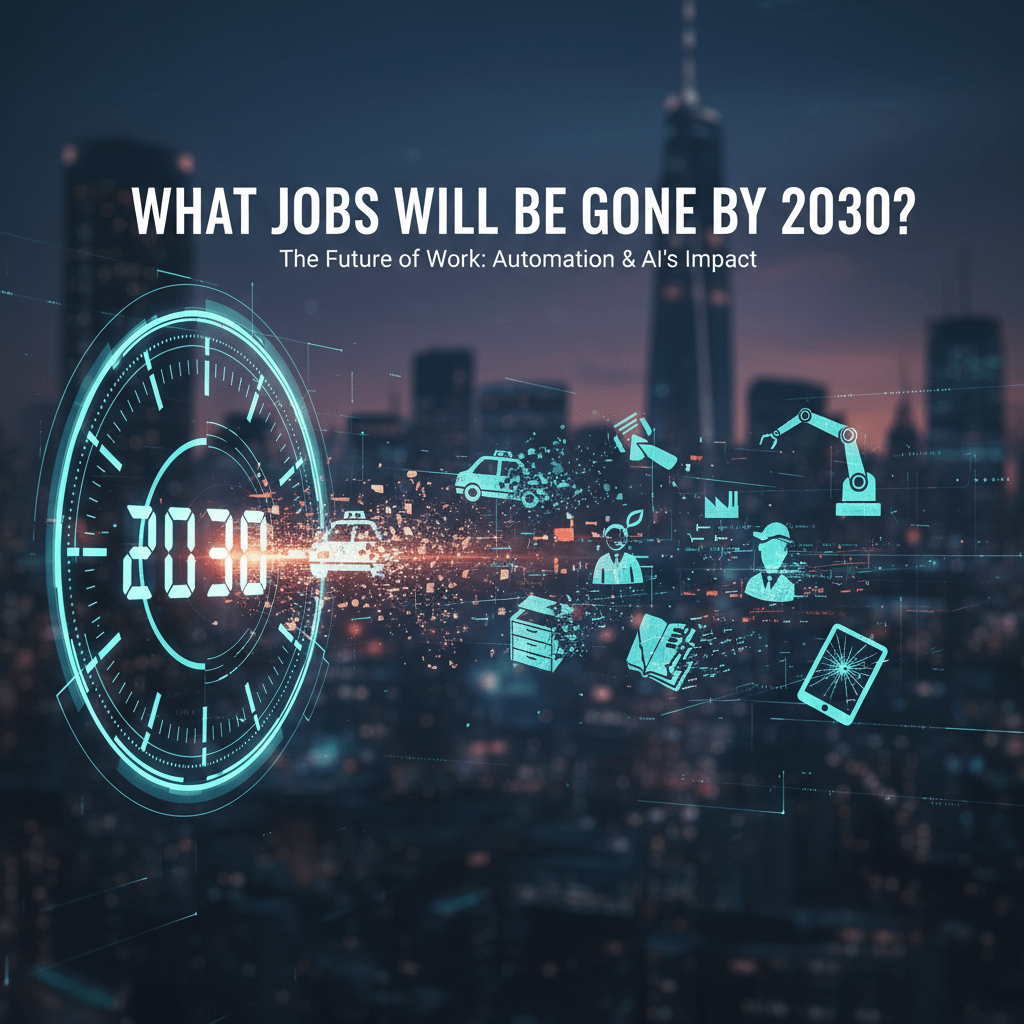
Ever feel like the future is hurtling towards us at warp speed? You’re not alone! The conversation around artificial intelligence (AI) and automation isn’t just about cool gadgets anymore; it’s about our livelihoods. We’re talking about a significant shift in the global job market, and it begs the question: what jobs will be gone by 2030?
It’s not a doomsday scenario, but a clear call to action. Understanding these trends is crucial for individuals looking to future-proof their careers and for businesses striving to remain competitive. By 2030, many roles we consider commonplace today could be unrecognizable or simply obsolete. Let’s dive into the fascinating, and sometimes scary, world of the evolving workforce.
Table of Contents
- Automation and AI: The Driving Forces Behind Jobs Gone by 2030
- Impacted Sectors and Roles: Where Jobs Will Be Gone by 2030
- Beyond Displacement: The Emergence of New Opportunities
- Preparing for the Future of Work: Skills and Strategies
- Frequently Asked Questions (FAQ)
- Conclusion
Automation and AI: The Driving Forces Behind Jobs Gone by 2030
Why are we even talking about jobs gone by 2030? The short answer is technology. Automation, fueled by advancements in AI and robotics, is no longer just a futuristic concept; it’s here, and it’s transformative. Think about it: everything from self-driving cars to sophisticated chatbots is becoming commonplace.
This isn’t just about robots replacing humans, either. It’s about software automating tasks that were once considered exclusively human. From data entry to complex analysis, AI is learning and adapting at an incredible pace, making many routine jobs ripe for automation.
The Rise of Robotic Process Automation (RPA)
Have you ever had to input data manually, day in and day out? It’s tedious, right? Well, Robotic Process Automation (RPA) software is designed to handle exactly those kinds of repetitive, rule-based tasks. It’s like having a digital employee that never sleeps, never makes a typo, and never complains.
RPA can fill out forms, process transactions, extract data, and even respond to basic customer inquiries. While it doesn’t replace an entire job, it significantly reduces the need for human input for these specific tasks, making roles focused solely on such activities increasingly redundant.
Generative AI and Its Expanding Capabilities
Beyond RPA, generative AI models like the one you’re interacting with right now are changing the game. They can create content, write code, design images, and even formulate strategies. This means jobs heavily reliant on basic content creation, administrative tasks, and even some levels of basic coding are feeling the heat.
Imagine a future where AI can draft legal documents with a few prompts, or design marketing campaigns from scratch. This isn’t science fiction; it’s becoming reality, fundamentally altering what “knowledge work” entails. What does this mean for professions that historically relied on these skills?
Impacted Sectors and Roles: Where Jobs Will Be Gone by 2030
So, which specific roles are most vulnerable to automation, leading to a significant number of jobs gone by 2030? Generally, any job characterized by repetitive tasks, predictable environments, and minimal need for complex human interaction or creativity is at risk. Let’s explore some key areas.
The World Economic Forum’s “Future of Jobs Report” consistently highlights this trend, indicating that while some jobs will disappear, many will also be augmented or created. It’s less about a wholesale disappearance and more about significant transformation.
The World Economic Forum Future of Jobs Report predicts a significant shift in job roles, with millions potentially displaced by 2030.
Administrative and Clerical Roles
These roles are often at the top of the “at-risk” list. Think about data entry clerks, administrative assistants, and receptionists. Many of their core tasks – scheduling, data management, document processing – can be efficiently handled by smart software and AI.
While human interaction and problem-solving elements will likely remain, the sheer volume of mundane tasks will diminish, shifting the focus of these roles significantly. It’s not that we won’t need administrative support, but the nature of that support will change dramatically.
Manufacturing and Assembly Line Workers
Historically, manufacturing has been a prime candidate for automation, and this trend is only accelerating. Robots can perform repetitive assembly tasks with incredible precision and speed, often outperforming humans in efficiency and consistency.
Complex tasks requiring fine motor skills or nuanced decision-making might still require human oversight, but for many standard production roles, the handwriting is on the wall. This shift has massive implications for economies reliant on large manufacturing workforces.
Transportation and Logistics
Self-driving vehicles, drone delivery, and automated warehouse management systems are already here. Truck drivers, delivery personnel, and even taxi drivers could see significant challenges as autonomous technologies become more refined and widely adopted.
The efficiency gains from these technologies are enormous, making their rollout almost inevitable. However, the human element in logistics – complex problem-solving during unforeseen delays, or nuanced customer interaction – will likely remain for some time.
Customer Service and Telemarketing
Chatbots and AI-powered voice assistants are becoming increasingly sophisticated. They can handle routine inquiries, process orders, and even troubleshoot basic problems. While complex or empathetic customer interactions will likely still require humans, a large percentage of frontline customer service jobs are vulnerable.
Remember those annoying telemarketing calls? AI can now make those too, personalize them, and even respond to some basic objections. This indicates a challenging future for human-led telecommunication roles.
Beyond Displacement: The Emergence of New Opportunities
It’s easy to focus on the negative, but the truth is, technology has always created more jobs than it destroys, albeit different ones. This wave of automation and AI system development is no different. Alongside the jobs gone by 2030, an exciting array of new roles will emerge.
Think about the internet; it didn’t just replace mail carriers, it gave us web developers, social media managers, SEO specialists, and an entire digital economy. The same principle applies here. The challenge is ensuring people have the skills to transition to these new opportunities.
AI Development and Ethics
Who designs these AI systems? Who ensures they are fair, unbiased, and safe? That’s where AI researchers, developers, and ethicists come in. These are high-demand roles that require specialized technical skills and a deep understanding of societal impact.
Companies like Digital Platforms are at the forefront of this, providing expert AI system development and consultation services to businesses seeking to leverage these new technologies responsibly and efficiently. They’re a prime example of an organization built on these future-proof skills.
Data Science and Analytics
AI thrives on data. Lots of it. And someone needs to collect, clean, analyze, and interpret that data. Data scientists, data engineers, and big data analysts will be crucial in making sense of the vast amounts of information generated by automated systems.
These roles involve statistics, programming, and domain expertise, making them highly sought after. They’re the people who turn raw data into actionable insights for businesses.
Human-AI Collaboration Specialists
As AI becomes more integrated into workplaces, we’ll need people who can bridge the gap between human and machine. These specialists will design interfaces, train AI, troubleshoot issues, and optimize workflows where humans and AI work side-by-side.
It’s about making sure the “co-bot” (collaborative robot) works seamlessly with its human counterpart, enhancing productivity rather than just replacing it.
Preparing for the Future of Work: Skills and Strategies
So, what can we do to ensure we’re not among the jobs gone by 2030? The key is adaptability and continuous learning. It’s not about fearing the change, but embracing it and equipping ourselves with the skills that machines can’t easily replicate.
The good news is that many of these skills are inherently human. The future job market will reward those who can think critically, create, empathize, and solve complex, unstructured problems.
McKinsey Global Institute’s research suggests that while many tasks will be automated, demand for human skills will grow significantly.
Embrace Lifelong Learning and Reskilling
The days of learning a trade once and practicing it for 40 years are largely over. We all need to become lifelong learners. This means constantly updating our skills, taking online courses, attending workshops, and even pursuing new certifications. Think of it as an ongoing subscription to your career growth.
Focus on skills that are complementary to AI, not competitive. Can you interpret the output of an AI? Can you prompt it effectively? Can you apply its insights to real-world problems? These are valuable competencies.
Cultivate “Uniquely Human” Skills
Machines are fantastic at logic and data, but they lack true creativity, emotional intelligence, critical thinking, and nuanced social skills. These are your superpowers in the age of AI. Developing these means investing in skills like:
- Creativity and Innovation: Brainstorming new ideas, artistic expression, problem-solving out of the box.
- Critical Thinking: Analyzing situations, evaluating information, making sound judgments.
- Emotional Intelligence: Understanding and managing emotions, empathy, building strong relationships.
- Complex Problem-Solving: Tackling ambiguous, multifaceted issues that lack clear solutions.
- Communication and Collaboration: Working effectively with diverse teams, articulating ideas clearly.
These are the skills that make us indispensable, even as machines become smarter. When you combine these ‘soft’ skills with digital literacy, you become a formidable force in the evolving job market.
Consider Entrepreneurship and Niche Specialization
As large industries automate, smaller, more specialized markets often emerge. Could you use AI tools to start your own business? Perhaps offer a highly personalized service that automation can’t replicate? Entrepreneurship, fueled by technology, offers incredible flexibility and opportunity.
Becoming an expert in a very specific, high-value niche can also future-proof your career. Instead of being a generalist, become the go-to person for a unique combination of skills or a complex problem that still requires human finesse.
Moreover, businesses looking to navigate this complex landscape often turn to professional services providers like Digital Platforms. Their expertise in web development, custom software, and consultations helps businesses pivot, innovate, and thrive. They have a proven track record of helping happy clients future-proof their operations.
Frequently Asked Questions (FAQ)
Will all manual labor jobs be gone by 2030?
Not all, but many routine manual labor jobs are highly susceptible to automation. Tasks requiring complex dexterity, problem-solving, or human interaction will likely remain or evolve.
How can I prepare for potential job displacement by 2030?
Focus on developing ‘uniquely human’ skills like creativity, critical thinking, emotional intelligence, and complex problem-solving. Lifelong learning and adaptability are key, along with exploring new technologies like AI and data science.
What new jobs might emerge by 2030?
The rise of AI and automation will create new roles in areas like AI development and ethics, data science, human-AI collaboration, robotics maintenance, and personalized education/healthcare. Green economy jobs will also see significant growth.
Is it inevitable that robots will take all our jobs?
No, it’s not inevitable. While automation will transform the job market, history shows that technological advancements also create new jobs and increase productivity. The challenge is managing this transition and ensuring equitable access to new opportunities.
How will AI system development impact the job market by 2030?
AI system development will be a major driver of job transformation. It will displace repetitive tasks while creating new high-skilled jobs in AI research, engineering, data analysis, and ethical oversight. Companies like Digital Platforms are at the forefront of this evolution, guiding businesses through AI adoption.
Conclusion
The idea of jobs gone by 2030 might feel daunting, but it’s also a powerful catalyst for growth and innovation. The future of work isn’t about humans vs. machines; it’s about humans and machines working together, each playing to their strengths. While some roles will undoubtedly diminish or disappear, a wealth of new, exciting opportunities will emerge.
The key takeaway? Don’t be a passive observer. Be an active participant in shaping your own future and the future of work. Invest in your uniquely human skills, embrace lifelong learning, and stay curious about emerging technologies. The landscape is shifting, but with foresight and preparation, we can all thrive in the age of AI.
For information or free consultation, visit our services pages and send us an email: www.digitalplatforms.co.za.