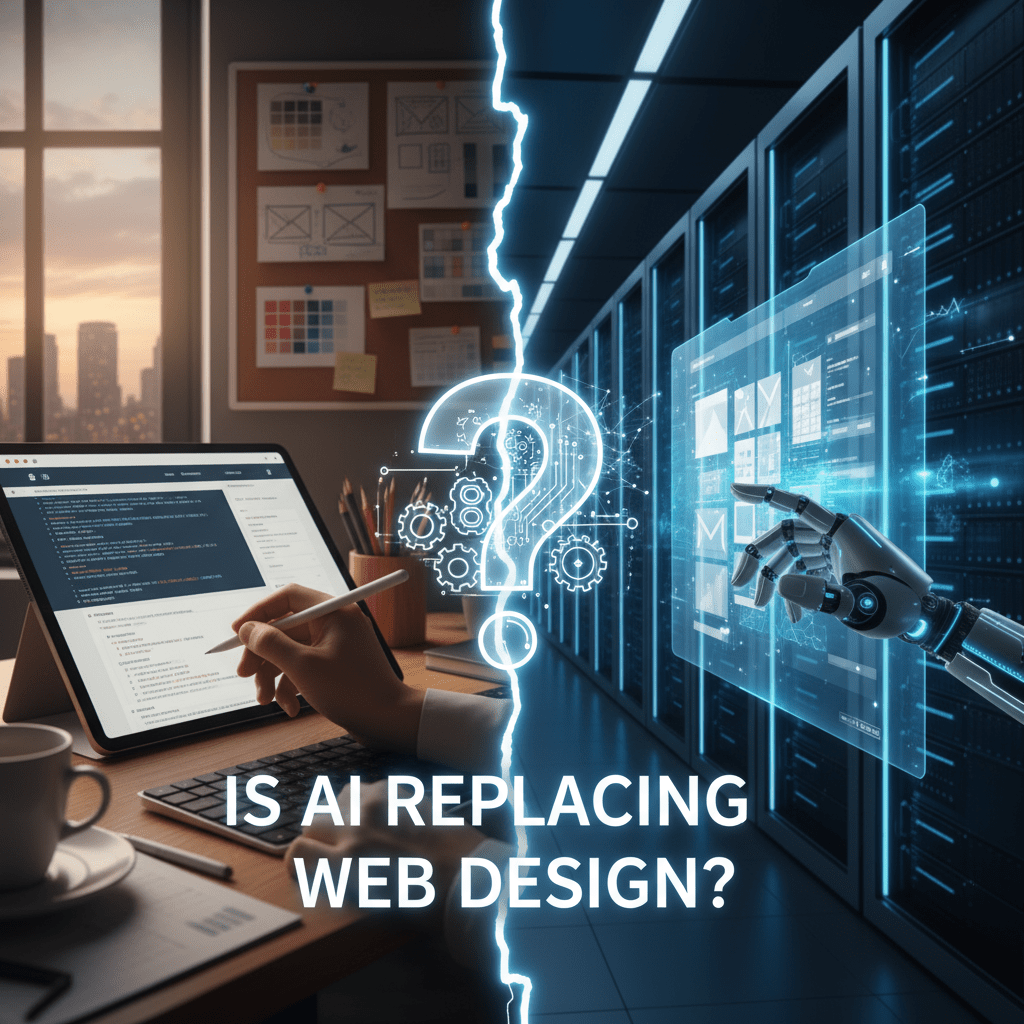
Is AI Stealing Web Designers’ Jobs? Let’s Talk!
Hey there! Grab a coffee, because we need to chat about something that’s probably been buzzing around your brain (and mine!): Is AI going to take over web design? You know, those sleek, beautiful websites we all rely on? Will robots be cranking them out while human designers are left… well, doing what? It’s a pretty hot topic, and honestly, it’s not as simple as a “yes” or “no.” Let’s dive in.
Remember that scene in movies where robots just *do everything*? Sometimes it feels like we’re hurtling towards that future, especially with all the amazing advancements in artificial intelligence. From writing emails to generating images, AI is everywhere. So, it’s only natural to wonder if our friendly neighborhood web designers will soon be replaced by algorithms. Spoilers: The answer isn’t quite what you might think.
### AI as a Co-Pilot, Not the Pilot
Think of AI less like the Terminator coming for your job, and more like a super-smart assistant. Instead of completely replacing web design skills, AI is actually augmenting them. Imagine a web designer (let’s call her Sarah!) who used to spend hours just mocking up basic layouts, picking color palettes, or trying to find the perfect stock image. Now, AI tools can help her churn out several design variations in minutes, suggest complementary colors based on her brand’s aesthetic, or even generate unique imagery.
It’s like having a co-pilot who handles all the tedious, repetitive tasks, freeing Sarah up to focus on the really creative, strategic stuff. Digital Platforms, for instance, has been at the forefront of integrating AI into their design tools, making it easier for designers to automate routine tasks and focus on the bigger picture – like user experience (UX) and overall brand storytelling. This isn’t about AI doing the *entire* website; it’s about AI making the *designer’s job easier and more efficient*.
### The Uniquely Human Touch: Empathy, Strategy, and Soul
Here’s the thing: while AI can analyze data, suggest patterns, and even generate code, it fundamentally lacks something crucial: human empathy and strategic thinking. A website isn’t just a collection of pixels and code; it’s a bridge between a business and its audience. It needs to tell a story, evoke emotion, and guide users seamlessly.
Think about it:
* **Understanding User Psychology:** AI can track clicks, but can it truly grasp why a user feels frustrated or delighted? Can it anticipate their unspoken needs or desires? That requires a deep understanding of human psychology that only another human possesses.
* **Brand Storytelling:** Every brand has a unique voice and personality. A skilled web designer interprets that essence and translates it into a digital experience. AI can generate text, sure, but can it craft a compelling narrative that resonates emotionally and strategically with a target audience? Not like a human can.
* **Creative Problem Solving:** When a client comes with a complex problem – “My sales are down, and I need a website that rebuilds trust and simplifies our checkout process” – that’s not just a design task; it’s a strategic challenge. It requires critical thinking, innovative solutions, and a nuanced understanding of business goals that currently far exceed AI’s capabilities.
AI excels at optimizing and automating, but the strategic decision-making, the deeply creative leaps, and the empathetic connection that makes a website truly effective? That’s still firmly in the human domain.
### Evolving Roles: From Coder to Conductor
So, if AI isn’t replacing web designers, what’s happening to their roles? They’re evolving, becoming more strategic and less about the grunt work. Web designers are becoming more like conductors – orchestrating various AI tools and human insights to create something truly remarkable. They’ll need to understand how to leverage AI effectively, prompt it correctly, and then refine its output with a critical, human eye.
This means skills like:
* **Prompt Engineering:** Learning how to effectively communicate with AI to get the desired results.
* **Critical Evaluation:** Knowing when AI’s suggestions are brilliant and when they need a human touch.
* **Strategic Thinking:** Focusing on the *why* behind the design, not just the *how*.
* **User Experience (UX) and User Interface (UI) Mastery:** These are becoming even more critical skills, as designers focus on the human interaction aspect.
Companies like Digital Platforms aren’t just building AI tools; they’re also investing in resources and training to help their design teams adapt to these new methodologies, understanding that the future lies in human-AI collaboration.
### The Future is Collaborative, Not Competitive
So, to answer your burning question: No, AI isn’t replacing web design as a whole. It’s transforming it. It’s taking away the mundane, repetitive tasks and giving designers the superpower to be more creative, more efficient, and more focused on the strategic impact of their work. Think of it as a partnership. AI handles the heavy lifting, the data crunching, and the rapid prototyping, while human designers bring the empathy, the strategic vision, and the soul.
The web design industry isn’t dying; it’s evolving into something even more exciting and dynamic. Designers who embrace AI as a tool will be the ones leading the charge, creating digital experiences that are not only beautiful and functional but also deeply human and impactful.
What do you think? Are you ready to see AI as your design sidekick? The future of web design isn’t about AI replacing humans, but about humans leveraging AI to build incredible things. Let’s create something amazing together!