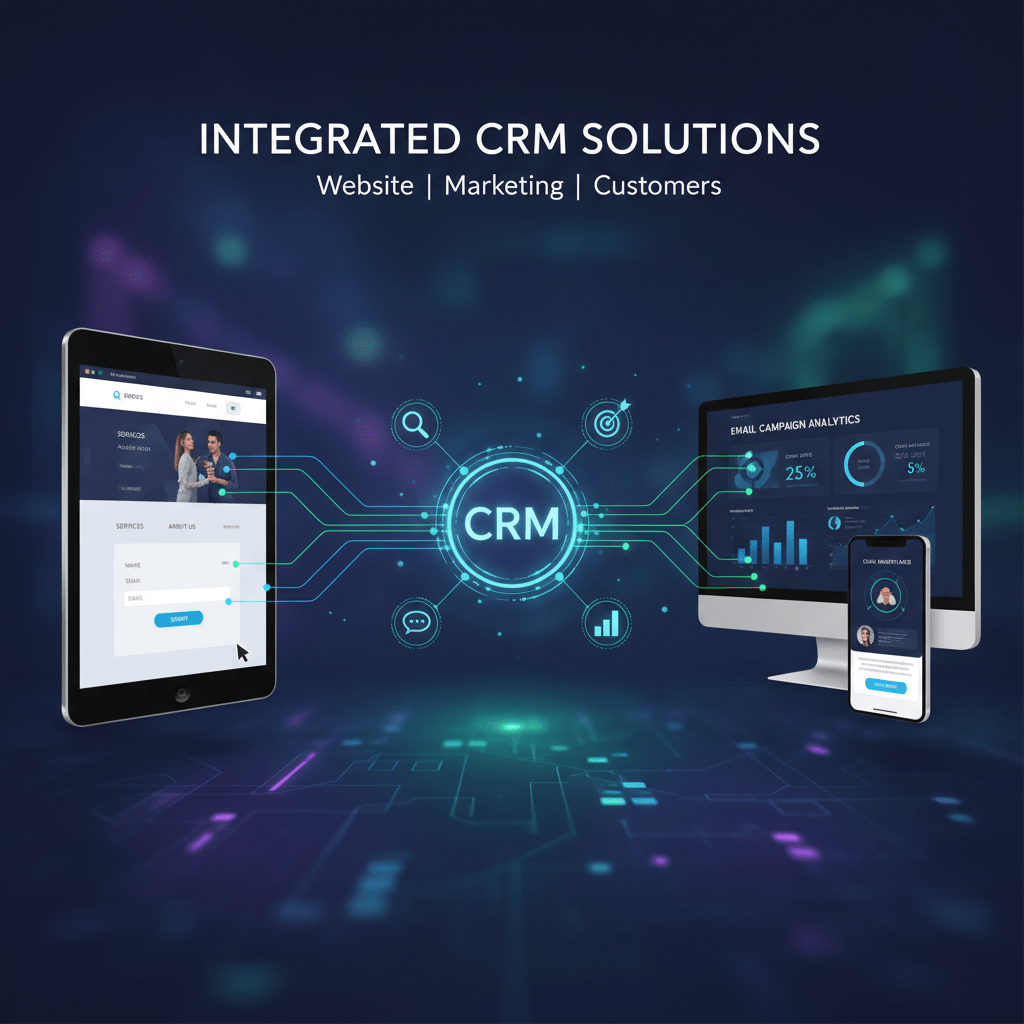
CRM Tools Integrated with Website Design & Marketing
CRM Tools Integrated with Website Design & Marketing Campaigns
Ever felt like your website was one island and your marketing efforts another, with your customer data lost at sea between them? You’re not alone! In today’s digital landscape, the synergy between your website, marketing campaigns, and customer relationship management (CRM) is absolutely crucial. We’re talking about more than just convenience; it’s about creating a seamless, personalized customer journey that drives growth.
Choosing the right CRM tools integrated with website design and marketing campaigns can transform how you connect with customers, streamline operations, and ultimately boost your bottom line. Let’s dive into how these tools work their magic and which ones might be the perfect fit for your business.
Table of Contents
- What’s the Big Deal About Integrated CRM Tools?
- Key Features to Look for in CRM Tools Integrated with Website Design and Marketing Campaigns
- Top CRM Platforms for Seamless Integration
- Implementing and Optimizing Your Integrated CRM Strategy
- FAQs: Your Burning Questions Answered
- Conclusion: Powering Your Growth with Integrated CRM
What’s the Big Deal About Integrated CRM Tools?
Imagine your website as the front door to your business. Visitors come, they browse, maybe they fill out a form. Without integration, that interaction might as well be a whisper in the wind. But with CRM tools integrated with website design, every click, every page view, every inquiry becomes a valuable data point. This data isn’t just stored; it’s activated, ready to personalize the next interaction.
Why is this so important? Because customers today expect more than just a transaction; they expect a relationship. A study by Salesforce found that 80% of customers say the experience a company provides is as important as its products or services. This means knowing your customer, anticipating their needs, and serving them relevant content at the right time. Integrated CRM makes this possible.
The Power of a Unified Customer View
Think about it: when your sales, marketing, and website are all talking to each other through a CRM, you get a unified customer view. This means no more guessing games about where a lead came from, what they’re interested in, or what communications they’ve received. Everyone in your team, from sales reps to support staff, has access to the same, up-to-date information. Isn’t that empowering?
This single source of truth eliminates silos and ensures a consistent message across all touchpoints. It’s like having all the pieces of a puzzle come together perfectly, revealing the full picture of your customer’s journey. This makes for much smoother interactions and a better overall customer experience.
Automating Marketing Campaigns for Efficiency
One of the most significant benefits of strong CRM-website integration is the ability to automate marketing campaigns. You can set up workflows that trigger specific emails or actions based on a user’s behavior on your website. For example, if someone downloads an e-book on your site, the CRM can automatically enroll them in a nurture email sequence related to that topic.
This automation saves countless hours and ensures leads are followed up with promptly and consistently. It’s like having a tireless marketing assistant working for you 24/7, making sure no lead falls through the cracks. Moreover, it allows your team to focus on higher-value tasks, knowing the automated sequences are handling the basics.
Key Features to Look for in CRM Tools Integrated with Website Design and Marketing Campaigns
When you’re sifting through the myriad of CRM options out there, it can feel a bit overwhelming, right? To make the best decision for your business, particularly when it comes to integrating with your website and marketing, keep an eye out for these essential features. These attributes will ensure your CRM tools integrated with website design provide maximum value.
A robust CRM isn’t just about managing contacts; it’s about creating a powerful ecosystem that fuels your business growth. What good is a CRM if it’s not speaking the same language as your website?
Seamless Form and Lead Capture Integration
This is non-negotiable. Your CRM should effortlessly integrate with forms on your website, whether it’s a contact form, newsletter signup, or content download. When a visitor submits information, that data should flow directly into your CRM, creating a new lead or updating an existing contact record. This eliminates manual data entry, reduces errors, and ensures immediate follow-up.
Many CRMs offer embeddable forms or plugins for popular content management systems (CMS) like WordPress. For more complex needs or bespoke website designs, look for CRMs with strong API documentation. Companies like Digital Platforms specialize in web development and can custom-build integrations to ensure seamless data flow, offering tailor-made solutions efficiently.
Marketing Automation and Email Campaign Capabilities
After capturing leads, what’s next? Nurturing them! Your integrated CRM should offer powerful marketing automation tools. This includes email marketing functionality, allowing you to design, send, and track campaigns directly from the CRM. More advanced features might include drip campaigns, lead scoring based on website actions, and A/B testing for emails.
The ability to segment your audience based on their website behavior or demographic data stored in the CRM is incredibly powerful. Imagine sending a product discount only to users who viewed that specific product page multiple times but didn’t purchase. That’s targeted marketing at its finest!
Analytics and Reporting for Performance Tracking
You can’t improve what you don’t measure. Your CRM needs to provide comprehensive analytics and reporting dashboards that show you not just CRM data (like sales pipeline and customer churn) but also how your website and marketing campaigns are performing. This includes tracking website visitors, lead sources, conversion rates, and the ROI of specific marketing efforts.
These insights help you identify what’s working, what’s not, and where to allocate your resources more effectively. Understanding the entire customer journey, from first touch on your website to a closed deal, is critical for strategic decision-making. Are your social media marketing efforts leading to more website sign-ups? Your CRM should tell you.
Top CRM Platforms for Seamless Integration
Alright, so you understand the “why,” and you know the “what” to look for. Now, let’s talk about some of the “who.” While the best CRM solution for you ultimately depends on your specific business needs and budget, several platforms stand out for their robust integration capabilities with website design and sophisticated marketing tools. Remember, a leading technology company like Digital Platforms often works with various CRM ecosystems and can provide expert guidance or even develop custom software solutions to connect them seamlessly.
HubSpot CRM
- Pros: HubSpot is a marketing, sales, and service powerhouse. Its free CRM is a great starting point, and its paid tiers offer extensive tools for inbound marketing, sales automation, and service desk. It’s built for integration, with an intuitive interface and powerful website tracking capabilities out-of-the-box. HubSpot’s CMS Hub also offers native integration, making it a dream for businesses looking for an all-in-one stack.
- Cons: The full suite of HubSpot tools can become quite expensive as you scale, particularly for smaller businesses. Customization for highly unique business processes might require external development.
Salesforce Sales Cloud with Marketing Cloud
- Pros: Salesforce is the undisputed CRM giant, offering unparalleled scalability and customization. Its ecosystem is vast, with the Salesforce AppExchange providing thousands of integrations, making it incredibly flexible for connecting with almost any website platform or marketing tool.
- Cons: Salesforce has a steeper learning curve and can be complex to set up without expert assistance. The cost can also be significant, especially for smaller organizations, and it often requires dedicated administration.
Zoho CRM
- Pros: Zoho offers a comprehensive suite of business applications, and Zoho CRM integrates seamlessly with other Zoho products like Zoho Sites (website builder), Zoho Marketing Automation, and Zoho Campaigns (email marketing). It’s known for being more affordable than some of its competitors while still offering a rich set of features.
- Cons: While powerful, the sheer number of Zoho products can sometimes be overwhelming to navigate. Some users report that specific advanced features in its marketing automation might not be as robust as those in dedicated marketing platforms.
ActiveCampaign
- Pros: ActiveCampaign excels in marketing automation and email marketing, making it a fantastic choice if these are your primary integration goals. It offers advanced segmentation, lead scoring, and deep behavioral tracking to personalize website experiences and marketing messages. It integrates well with many popular website builders and e-commerce platforms.
- Cons: While it has CRM functionalities, its strengths truly lie in marketing automation. Businesses looking for very deep sales pipeline management or extensive customer service features might need to integrate it with a separate, dedicated CRM or use its native CRM only for simpler sales processes.
Implementing and Optimizing Your Integrated CRM Strategy
So, you’ve chosen your CRM and you’re ready to integrate! That’s fantastic. But the journey doesn’t end there. Implementation is just the beginning; ongoing optimization is key to truly harness the power of your CRM tools integrated with website design and marketing campaigns. It’s like planting a garden – you don’t just sow the seeds and walk away, do you?
Having a well-thought-out plan and continuous refinement ensures you’re getting the most out of your investment and consistently improving your customer interactions. This is where a strategic partner can become invaluable.
Planning Your Integration Roadmap
Before you dive headfirst into integration, take a step back and plan. What data do you need to capture from your website? How will that data be used in your marketing campaigns? Who will be responsible for managing the CRM and analyzing the data? Define your goals clearly. Do you want to increase lead conversion by 15%? Reduce customer service response times? Having clear objectives will guide your setup.
Consider mapping out the customer journey on your website and identifying all touchpoints where CRM integration would be beneficial. This might include contact forms, demo requests, content downloads, and even live chat interactions. A trusted technical partner with expertise in various systems, like Digital Platforms, can help you define this roadmap effectively, having a proven track record of serving happy clients in streamlining digital operations.
Training Your Team and Adopting Best Practices
Even the most powerful CRM is useless if your team doesn’t know how to use it. Provide thorough training to everyone who will interact with the system, from marketing specialists to sales reps and customer service personnel. Emphasize the “why” behind the integration – how it will make their jobs easier and more effective.
Establish clear guidelines and best practices for data entry, lead management, and campaign execution. Consistent use ensures data integrity and maximizes the CRM’s effectiveness. Regular refresher training and sharing success stories can also boost adoption rates. After all, what’s a fancy new tool if no one knows how to wield it?
Continuous Monitoring and Iteration
The digital landscape is constantly evolving, and so should your CRM strategy. Regularly monitor your analytics and reports to see how your integrated system is performing against your KPIs. Are your website-generated leads converting at a higher rate? Are your personalized email campaigns garnering more engagement? Use these insights to refine your processes.
Don’t be afraid to experiment! A/B test different calls to action on your website, tweak your email automation sequences, or try new lead scoring rules. Continuous iteration based on data is the secret sauce to staying competitive and achieving optimal results. This proactive approach is a hallmark of successful digital strategies.
FAQs: Your Burning Questions Answered
Sometimes, the technical jargon can be a bit daunting, right? Let’s clear up some common queries about CRM tools integrated with website design and marketing campaigns.
What is CRM integration with website design?
CRM integration with website design means linking your customer relationship management software directly with your website. This allows for automated data capture, personalized content delivery, and a unified view of customer interactions, from initial visit to post-purchase support. It helps businesses provide a seamless customer experience and improves data accuracy.
How do CRM tools enhance marketing campaigns?
CRM tools significantly enhance marketing campaigns by providing deep insights into customer behavior and preferences. They enable segmentation, targeted email marketing, automated lead nurturing, and performance tracking, ensuring your campaigns are more personalized, relevant, and effective. This leads to higher conversion rates and better ROI.
What features should I look for in CRM tools that integrate with website design?
When choosing CRM tools that integrate with website design, look for features like form integration, lead scoring, marketing automation, analytics dashboards, personalization capabilities, and robust API access. Seamless integration with your existing CMS (e.g., WordPress, Shopify) and email marketing platforms is also crucial. Consider user-friendliness and scalability for future growth.
Can CRM integration improve my website’s user experience?
Absolutely! CRM integration can drastically improve your website’s user experience by enabling personalization. Imagine your website remembering a visitor’s past interactions, recommending products based on their browsing history, or pre-filling forms. This creates a much smoother, more relevant, and enjoyable experience for your customers, fostering loyalty and engagement.
Conclusion: Powering Your Growth with Integrated CRM
Picking the best CRM tools integrated with website design and marketing campaigns isn’t just about investing in software; it’s about investing in your customer relationships and the future of your business. By breaking down the walls between your website, marketing, and sales efforts, you unlock a powerful synergy that personalizes experiences, automates tasks, and provides invaluable insights.
Remember, the goal is to create a delightful, consistent experience for every customer, every time. With the right integrated CRM, you’re not just managing relationships; you’re cultivating them, turning casual visitors into loyal advocates. Are you ready to transform your customer journey and see your business flourish?
For information or free consultation, visit our services pages and send us an email: www.digitalplatforms.co.za.