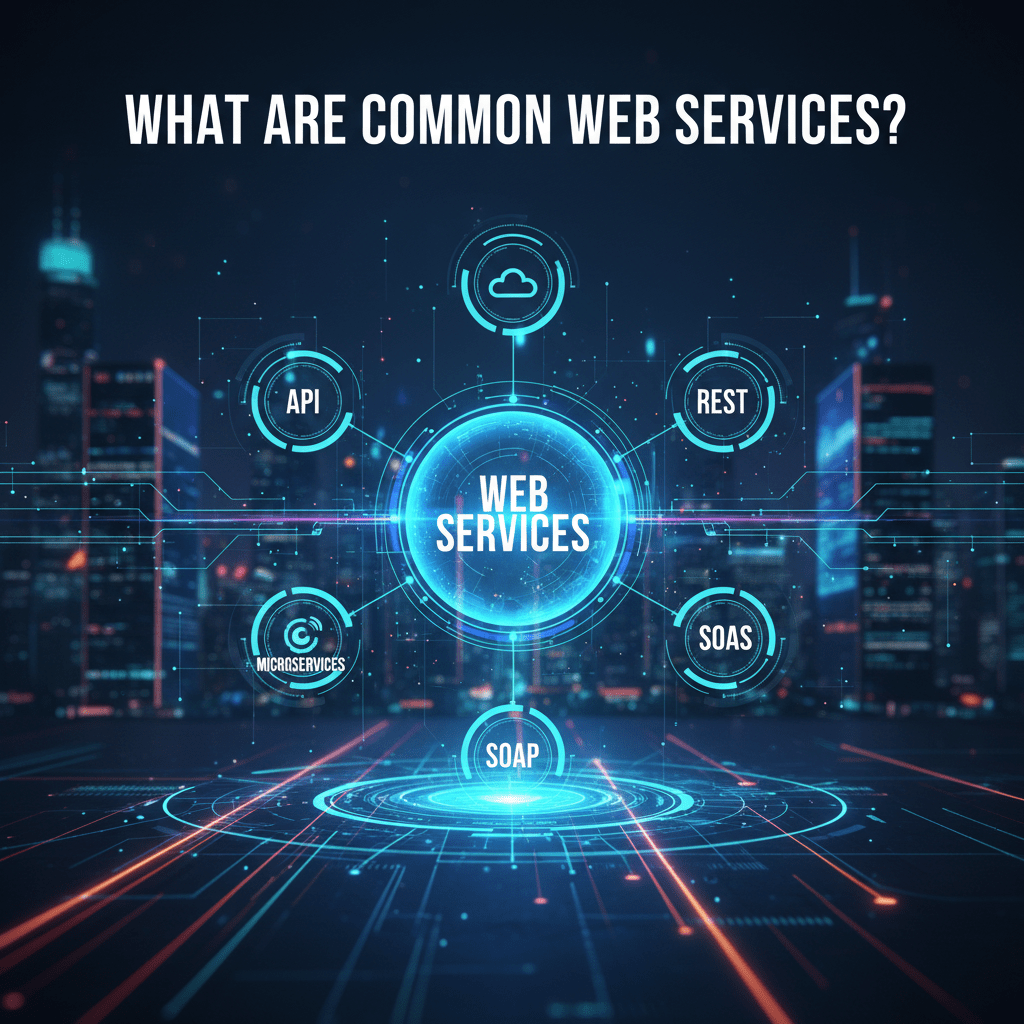
Common Web Services Demystified
Common Web Services Demystified: Your Guide to Interconnected Apps
Ever wondered how different applications, like your banking app and your favorite food delivery service, manage to talk to each other so seamlessly? It’s not magic, it’s the power of common web services! In today’s hyper-connected digital world, applications rarely live in isolation. Instead, they rely on a sophisticated network of services to share data, perform tasks, and deliver the rich experiences we’ve come to expect. Think of it like a bustling city where different buildings, each with its own specialty, can easily communicate and exchange resources thanks to well-defined roads and communication lines.
This article will pull back the curtain on what common web services are, why they’re indispensable, and give you a tour of the most prevalent types you’ll encounter. Whether you’re a budding developer, a business owner looking to understand your tech stack, or just curious about how the internet really works, you’ve come to the right place. We’ll explore the underlying technologies that make modern computing possible, ensuring you leave with a clear understanding of these fundamental building blocks. You’ll soon see that understanding these services is key to understanding the digital landscape.
Table of Contents
- What Exactly Are Common Web Services?
- Why Do We Need Common Web Services? The Interoperability Imperative
- The Two Giants: SOAP vs. REST in Common Web Services
- Beyond SOAP and REST: Other Common Web Services You Should Know
- Building with Common Web Services: Applications in the Real World
- FAQs About Common Web Services
- Conclusion: The Future is Interconnected
What Exactly Are Common Web Services?
At its core, a common web service is simply a standardized way for two different applications to communicate over a network, typically the internet. Imagine you have a fantastic weather app, but it doesn’t know anything about predicting temperatures. Instead of building a complex weather prediction engine from scratch (which would be a massive undertaking!), your app can “ask” a dedicated weather service for the forecast. That interaction, facilitated by a set of rules and protocols, is a web service.
These services are essentially software components that provide specific functionalities to other applications. They’re designed for machine-to-machine interaction, making them highly efficient for data exchange. The beauty of these services lies in their ability to overcome language and platform barriers. A web service written in Java can easily communicate with an application built in Python or C#, as long as they agree on the communication standards.
The Interoperability Principle
The magic word here is interoperability. Common web services are all about allowing diverse systems to work together seamlessly. This means a service running on a Linux server can effortlessly exchange data with an application running on a Windows machine, all without compromising functionality. It’s like having universal translators for different software languages.
Key Characteristics
- XML and JSON Messaging: Many web services use XML (eXtensible Markup Language) or JSON (JavaScript Object Notation) for structuring the data they exchange. These formats are human-readable and machine-parseable, making them ideal for data transmission.
- Standard Protocols: They rely on standard internet protocols like HTTP (Hypertext Transfer Protocol) for communication. This ensures they can easily traverse network firewalls and communicate globally.
- Self-Describing: Good web services often come with descriptions of their capabilities, allowing other applications to understand how to interact with them without prior knowledge.
Why Do We Need Common Web Services? The Interoperability Imperative
In a world where businesses depend heavily on digital efficiency, why are common web services so critical? Simple: they enable an ecosystem where different software components can be reused and combined to create powerful new applications. Think about it – if every application had to build every feature from scratch, innovation would slow to a crawl. Web services are like LEGO bricks for software development.
This paradigm fosters rapid development and reduces costs. Instead of a developer spending months creating a payment gateway, they can integrate an existing, reliable payment web service in a fraction of the time. This efficiency is invaluable for businesses striving to stay competitive. A recent study indicated that companies leveraging APIs and web services for integration can achieve up to a 31% faster time to market for new products and services.
Enabling Modular Architectures
Web services are key to building applications using microservices architecture, where an application is broken down into smaller, independent services. Each service handles a specific business function and communicates with others using web services. This design makes applications more scalable, resilient, and easier to maintain. Imagine upgrading just one small part of your engine instead of the entire car each time!
Facilitating Business-to-Business (B2B) Integration
For B2B interactions, common web services are indispensable. Companies can securely share inventory data, order information, or logistics details with their partners and suppliers in real-time. This automation dramatically reduces manual errors and speeds up business processes. For instance, a retailer can automatically send purchase orders to a supplier’s system, and the supplier’s system can confirm stock availability – all through web service calls.
The Two Giants: SOAP vs. REST in Common Web Services
When we talk about common web services, two acronyms almost always dominate the conversation: SOAP and REST. These are the two primary architectural styles or protocols for building and using web services. While both achieve the goal of inter-application communication, they do so with fundamentally different philosophies.
SOAP: The Protocol with a Pedigree
SOAP (Simple Object Access Protocol) is a messaging protocol defined by the World Wide Web Consortium (W3C). It’s highly structured and relies heavily on XML for message formatting. Think of SOAP as a very formal letter, complete with a structured envelope (the SOAP envelope), specific headers, and a body for the actual message. It needs a formal agreement (WSDL – Web Services Description Language) for client and server to communicate effectively.
- Strict Standards: SOAP follows rigid standards, making it very robust for complex enterprise environments where security and transaction compliance are paramount.
- Security Features: It offers built-in security features like WS-Security.
- Platform-independent: SOAP is entirely independent of the underlying transport protocol; it can use HTTP, SMTP, TCP, or JMS.
While powerful, SOAP can sometimes feel a bit heavy and complex due to its verbosity and strictness. It’s often preferred for legacy systems or applications requiring highly reliable and ACID-compliant transactions.
REST: The Lightweight, Flexible Architect
REST (Representational State Transfer) is not a protocol but an architectural style. It leverages standard HTTP methods (GET, POST, PUT, DELETE) to interact with resources. Imagine REST as using the existing roads and traffic rules of the internet. You just tell the resource what you want to do using standard HTTP verbs, and it responds. This simplicity is why RESTful APIs are incredibly popular today.
- Simplicity: REST is generally simpler to implement and understand than SOAP.
- Statelessness: Each request from a client to a server contains all the information needed to understand the request. The server doesn’t store any client context between requests.
- Leverages HTTP: It directly uses HTTP for communication, making it highly compatible with web browsers and infrastructure.
- Variety of Data Formats: While often using JSON, REST can return data in various formats like XML, HTML, or even plain text.
Given its flexibility and ease of use, REST is the go-to choice for most modern web, mobile, and IoT applications. A massive 83% of all public APIs are now RESTful, highlighting its dominance in the API economy.
Beyond SOAP and REST: Other Common Web Services You Should Know
While SOAP and REST steal much of the spotlight when discussing common web services, the landscape is richer than just these two. Other powerful technologies and concepts contribute to the interconnected digital ecosystem. Understanding these can give you a more complete picture of how modern applications communicate.
GraphQL: The Data Fetching Powerhouse
GraphQL is an open-source query language for APIs and a runtime for fulfilling those queries with your existing data. Developed by Facebook, it allows clients to request exactly the data they need, nothing more, nothing less. This eliminates over-fetching or under-fetching of data, common issues with traditional REST APIs. Think of it as placing a custom order at a restaurant, specifying every ingredient you want, rather than picking from a fixed menu.
- Efficient Data Fetching: Clients can specify required fields, leading to fewer network requests.
- Strongly Typed: GraphQL APIs are defined by a schema, ensuring consistency and making development easier.
- Real-time Capabilities: Subscriptions in GraphQL allow clients to receive real-time updates when data changes.
WebHooks: Event-Driven Communication
WebHooks are user-defined HTTP callbacks. Essentially, they allow one application to “listen” for events in another application and react to them in real-time. Instead of constantly asking, “Has anything new happened yet?”, a WebHook waits for the event to occur and then sends a notification. For example, a payment provider might use a WebHook to notify your e-commerce platform the moment a customer’s payment is successful. This proactive communication is incredibly efficient.
- Real-time Updates: Ideal for scenarios requiring immediate data synchronization or notifications.
- Reduced Polling: Eliminates the need for applications to constantly check for updates, saving resources.
gRPC: High-Performance RPC Framework
gRPC (gRPC Remote Procedure Call) is an open-source remote procedure call (RPC) system developed by Google. It’s designed for high-performance communication, especially between microservices. gRPC uses Protocol Buffers for data serialization, which are more efficient than JSON or XML, and HTTP/2 for transport. If you need lightning-fast communication within a distributed system, gRPC might be your answer.
- Performance: Known for its high performance and low latency.
- Polyglot: Supports many programming languages, making it suitable for diverse environments.
Building with Common Web Services: Applications in the Real World
So, we’ve talked a lot about what common web services are and the different types. But how do they actually manifest in the applications we use every day? The reality is, if you’re using a smartphone or browsing the internet, you’re interacting with dozens, if not hundreds, of web services daily without even realizing it.
Consider your favorite e-commerce site. When you add an item to your cart and proceed to checkout, there’s likely a series of web service calls happening behind the scenes:
- Your browser sends a request to a pricing service to confirm the item cost.
- It then talks to an inventory service to ensure the item is in stock.
- When you enter your shipping address, a mapping service (like Google Maps API) might validate it and calculate shipping costs.
- Finally, a payment gateway service processes your credit card details securely.
Each of these steps often involves distinct web services, all orchestrated to provide a seamless user experience. This level of integration is only possible because of well-defined APIs and protocols.
Digital Platforms: Expertise in Web Service Integration
When it comes to seamlessly integrating these complex web services, finding a reliable partner is crucial. This is where a company like Digital Platforms truly shines. Their expertise in custom software development and API integration means they can help businesses connect disparate systems, build powerful new applications, and streamline operations using the most efficient common web services available. They have a proven track record of serving happy clients by developing robust and scalable solutions that leverage these technologies effectively. Their team understands the nuances of various protocols, ensuring your systems communicate perfectly.
The Rise of the API Economy
The reliance on web services has led to what’s known as the “API Economy.” Businesses are now not just selling products or services, but also access to their data and functionalities through APIs. This creates new revenue streams and fosters partnerships, leading to innovation across industries. Does your business have an API strategy?
AI and IoT Integration
Even cutting-edge fields like Artificial Intelligence (AI) and the Internet of Things (IoT) are heavily reliant on common web services. AI models often consume data from various web services and expose their own functionalities as services. IoT devices collect vast amounts of data, which then needs to be transmitted and processed, often via web services, before being fed into analytical platforms or AI systems. Digital Platforms also excels in AI system development and IoT integration software, making them a go-to for businesses looking to connect these advanced technologies.
FAQs About Common Web Services
What is the primary purpose of common web services?
The primary purpose of common web services is to enable different software applications, often running on disparate systems, to communicate and exchange data over a network, typically the internet. They act as interoperable interfaces.
What’s the difference between SOAP and REST web services?
SOAP (Simple Object Access Protocol) is a protocol with strict standards and XML-based messaging, often favored for enterprise-level applications requiring high security and reliability. REST (Representational State Transfer) is an architectural style that’s simpler, more flexible, and uses standard HTTP methods, making it popular for web and mobile applications.
Can I build complex applications using common web services?
Absolutely! Common web services are the bedrock of modern, complex applications. By integrating various services like payment gateways, mapping services, or social media APIs, developers can build feature-rich and robust applications without reinventing the wheel for every single function.
How do web services handle security and authentication?
Web services employ various security measures, including HTTPS for encrypted communication, API keys, OAuth for authorization, and sometimes more complex protocols like WS-Security for SOAP. The choice depends on the web service type and the sensitivity of the data being exchanged.
What are microservices and how do they relate to common web services?
Microservices are an architectural approach where an application is built as a collection of small, independent services, each running in its own process and communicating via lightweight mechanisms, often common web services like RESTful APIs. This approach promotes modularity, scalability, and easier deployment.
Conclusion: The Future is Interconnected
We’ve taken quite a journey, haven’t we? From understanding the basic definition to exploring the nuances of SOAP, REST, GraphQL, WebHooks, and gRPC, it’s clear that common web services are far more than just technical jargon. They are the invisible threads that weave together the fabric of our digital world, making seamless interactions and complex functionalities possible across countless applications.
These services empower businesses to innovate faster, integrate disparate systems, and create richer experiences for their users. They are the silent workhorses behind almost every digital convenience we enjoy. As technology continues to evolve, the importance of robust, well-designed web services will only grow, especially with the ever-increasing demand for integrated AI and IoT solutions. Are you ready to harness their power?
Understanding and effectively utilizing common web services is key to building future-proof applications and staying competitive. Whether you’re integrating off-the-shelf APIs or developing custom software solutions, the principles of web services integration will underpin your success. Remember, in the digital age, isolation is seldom an option; connectivity is king!
For information or free consultation, visit our services pages and send us an email: www.digitalplatforms.co.za.