Big 4 AI Agents: Who’s Leading the Pack?
Big 4 AI Agents: Who’s Leading the Pack?
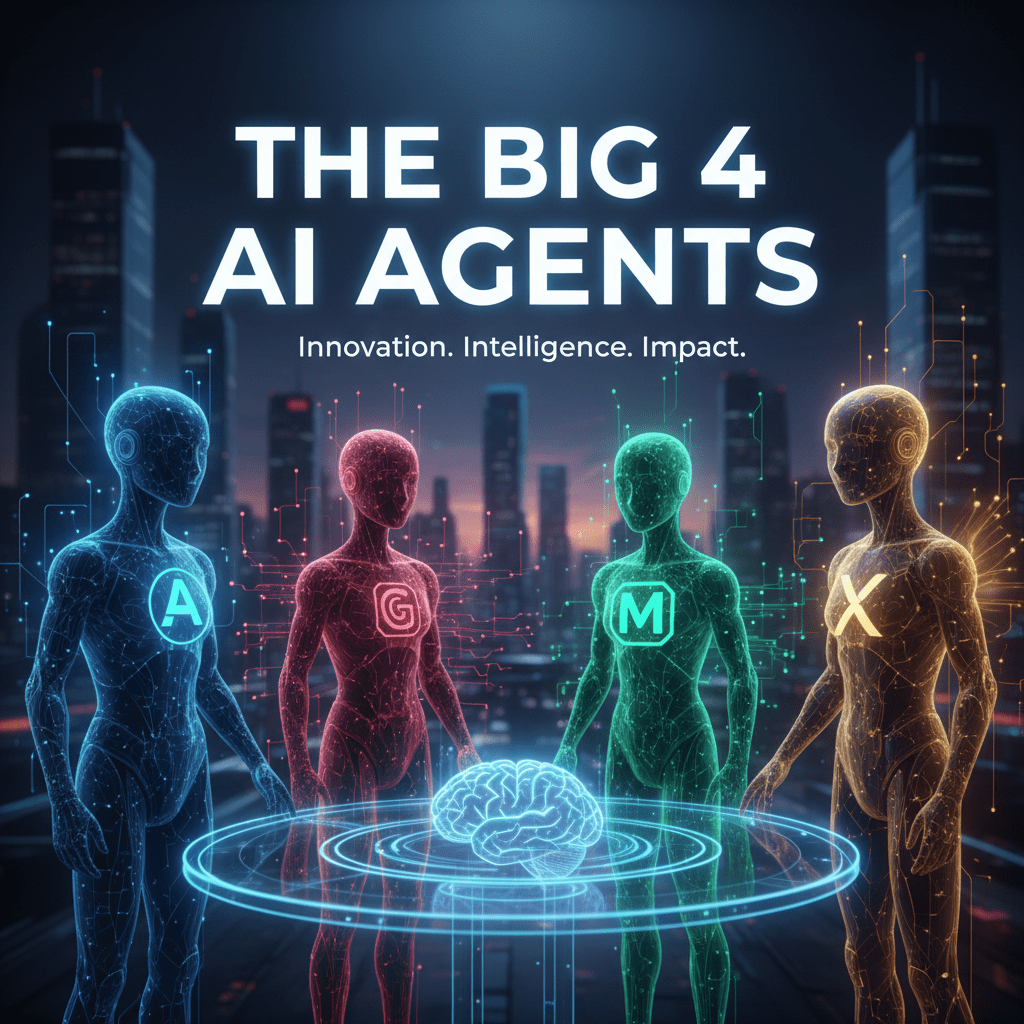
Ever wondered who’s truly at the helm of the artificial intelligence revolution? It feels like every day there’s a new breakthrough, a new buzzword, or another jaw-dropping application of AI. But when it comes down to the real heavy hitters, the organizations shaping the very future of this technology, a few names consistently rise to the top. We’re talking about the Big 4 AI Agents – the companies and research labs that are not just pushing boundaries but are actively redefining what’s possible with intelligent machines.
Understanding these dominant forces isn’t just for tech enthusiasts; it’s crucial for businesses, innovators, and anyone looking to navigate the increasingly AI-driven world. These Big 4 AI Agents are developing everything from sophisticated language models that can write poetry to advanced algorithms that power self-driving cars. So, buckle up! We’re about to dive deep into the world of AI’s power players.
Table of Contents
- Understanding the AI Landscape: What Defines a Leader?
- OpenAI: The Generative AI Frontrunner
- Google AI: Pervasive Intelligence
- Microsoft AI: Enterprise Dominance and Partnership
- Anthropic: Safety-First AI with a Conscience
- The Broader Impact of These Big 4 AI Agents
- FAQs About the Big 4 AI Agents
- Conclusion: The Evolving Race for AI Supremacy
Understanding the AI Landscape: What Defines a Leader?
Before we introduce our main contenders, let’s take a moment to clarify what makes an AI entity one of the “Big 4.” It’s not just about hype; it’s about measurable impact, substantial investment, and groundbreaking innovation. These companies aren’t simply adopting AI; they’re creating it from the ground up, setting industry standards, and influencing the direction of global technological advancement.
Key Criteria for AI Leadership
- Innovation & Research: Are they publishing cutting-edge research? Are they developing novel architectures and models?
- Market Adoption & Influence: Is their technology widely used? Are they shaping how other companies approach AI?
- Talent & Investment: Do they attract top AI researchers and engineers? Are they pouring significant resources into R&D?
- Ethical Frameworks: Are they actively addressing the societal and ethical implications of powerful AI?
These leading AI models are shaping our collective future, and their impact reverberates across every sector imaginable. Think about it: from how we search for information to how businesses operate, their fingerprints are everywhere.
OpenAI: The Generative AI Frontrunner
When you hear “generative AI” or “large language models,” one name almost immediately springs to mind: OpenAI. This organization exploded into the public consciousness with the release of ChatGPT, demonstrating to millions the incredible capabilities of sophisticated AI. They’ve truly democratized access to powerful AI tools, sparking a global conversation about the potential and perils of artificial intelligence.
From Research Lab to Global Phenomenon
OpenAI started as a non-profit in 2015 with a mission to ensure that artificial general intelligence (AGI) benefits all of humanity. While their structure has evolved, their core commitment to advanced AI research remains. Their flagship models, like the GPT (Generative Pre-trained Transformer) series and DALL-E, have showcased unprecedented abilities in natural language understanding, text generation, and image creation.
Their innovation has led to astounding growth. Consider this: ChatGPT reached 100 million users just two months after its launch, making it the fastest-growing consumer application in history. This kind of widespread adoption underscores their unparalleled influence on the artificial intelligence landscape.
Key Innovations and Offerings
- GPT Series (e.g., GPT-3.5, GPT-4): These large language models are capable of generating human-like text, translating languages, writing different kinds of creative content, and answering your questions in an informative way.
- DALL-E: An AI system that creates realistic images and art from a text description.
- Codex: The AI behind GitHub Copilot, capable of translating natural language into code.
OpenAI’s approach has often been one of rapid deployment, getting powerful tools into the hands of developers and users quickly. This swift iteration has undoubtedly cemented their place as one of the Big 4 AI Agents.
Google AI: Pervasive Intelligence
It’s hard to imagine the modern internet, or even modern computing, without Google. Naturally, their presence in the AI world is just as fundamental and far-reaching. Google AI isn’t just about a single product; it’s an interwoven fabric across virtually all of Google’s services, from search algorithms to autonomous driving with Waymo, and their powerhouse cloud infrastructure.
AI at the Core of Everything
Google has been a pioneer in AI and machine learning research for decades. Their work on deep learning, neural networks, and groundbreaking models like Transformer (the “T” in GPT!) has served as foundational building blocks for much of today’s AI advancements. They have an unparalleled data advantage, which fuels their machine learning algorithms, allowing them to train models on vast and diverse datasets.
What sets Google AI apart is its ubiquity. How many times a day do you interact with a Google AI-powered feature without even realizing it? Probably more than you think! From personalized recommendations on YouTube to spam filtering in Gmail, their AI touches billions globally.
Major Contributions and Platforms
- Google Gemini: Their most advanced and capable family of AI models, designed for multimodal reasoning and performance across various formats like text, code, audio, image, and video.
- TensorFlow: An open-source machine learning platform that has become a global standard for AI developers.
- Google Cloud AI: Offering a suite of AI and machine learning services for businesses, including Vision AI, Natural Language AI, and custom model training.
- DeepMind: A British artificial intelligence research laboratory acquired by Google, known for breakthroughs in AlphaGo and AlphaFold.
Google’s sheer scale and resources mean their influence as one of the prominent AI systems is profound and enduring. They truly represent the enterprise AI platforms that many businesses rely on.
Microsoft AI: Enterprise Dominance and Partnership
Microsoft isn’t just a software giant; it’s become a formidable player in the AI arena, largely due to its strategic investments and deep integrations. Their partnership with OpenAI, in particular, has elevated them to a prime position among the Big 4 AI Agents. This collaboration isn’t just financial; it’s a deep technological alliance that brings OpenAI’s cutting-edge models to Microsoft’s extensive enterprise and cloud ecosystem.
Strategic Alliances and Cloud Power
Microsoft’s approach to AI is multifaceted, combining internal research and development with crucial external partnerships. Their Azure cloud platform provides the computational horsepower needed to train and deploy massive AI models, making it a go-to choice for many AI startups and large enterprises alike. They understand that bringing AI to the enterprise requires robust infrastructure and seamless integration.
Their commitment to AI is clear: Microsoft has reportedly invested over $13 billion into OpenAI, demonstrating a belief in the transformative power of generative AI. This kind of investment highlights how serious they are about leading in this space.
Key Offerings and Integrations
- Azure AI: A comprehensive suite of AI services for developers, including pre-built models and tools for custom AI development, powered by Azure’s scalable infrastructure.
- Copilot: Integrating AI capabilities across Microsoft 365 applications (Word, Excel, PowerPoint, Outlook) to assist users with tasks, content creation, and analysis.
- Bing Chat (now Copilot): Leveraging OpenAI’s technology to enhance search capabilities with conversational AI.
- GitHub Copilot: An AI pair programmer that assists developers by suggesting code and entire functions in real-time.
Microsoft’s strategy focuses on making AI accessible and useful for its vast Windows and enterprise user base, proving that the Big 4 AI Agents are not just about research, but about practical, large-scale application.
Anthropic: Safety-First AI with a Conscience
While OpenAI, Google, and Microsoft have been making headlines with broad deployments, Anthropic has carved out a unique and increasingly influential niche. Founded by former OpenAI researchers concerned with AI safety, Anthropic is a leading AI developer that prioritizes ethical development, alignment, and robust safety measures above all else. They might be a smaller player in terms of market capitalization than the others, but their intellectual contributions and commitment to “Constitutional AI” place them firmly among the top AI developers.
Building Safe and Aligned AI
Anthropic’s philosophy centers on developing AI systems that are helpful, harmless, and honest. They believe that as AI becomes more powerful, ensuring its alignment with human values is paramount. This commitment has led them to develop innovative techniques like Constitutional AI, where an AI teaches itself to follow a set of principles, rather than relying solely on human reinforcement feedback, aiming to create more reliable and less harmful outputs.
Their approach is gaining traction, especially as concerns about AI bias, misuse, and control grow. Many view their work as crucial for the responsible scaling of advanced AI. Their focus isn’t just on making powerful models, but on making them trustworthy.
Flagship Models and Methodology
- Claude: Their family of large language models, designed to be helpful, harmless, and honest, often excelling in longer, more complex conversations and demonstrating strong reasoning abilities.
- Constitutional AI: A methodology for developing AI systems that learn from a set of guiding principles, reducing the need for extensive human oversight in the alignment process.
- Research on Interpretability & Robustness: Dedicated to understanding how AI models make decisions and making them more resilient to adversarial attacks or unexpected behavior.
Anthropic represents a vital counter-balance in the AI race, reminding us that power must be coupled with responsibility. They are undoubtedly one of the Big 4 AI Agents when it comes to steering the ethical development of the technology.
The Broader Impact of These Big 4 AI Agents
The innovation emanating from these Big 4 AI Agents isn’t contained within research labs; it’s actively reshaping entire industries. From healthcare to finance, manufacturing to creative arts, the ripple effects are profound and accelerating. These leading AI models are providing the foundational technology for myriad new applications.
Transforming Business Operations
Businesses globally are leveraging tools and insights derived from these AI powerhouses to enhance efficiency, personalize customer experiences, and drive innovation. For instance, imagine a company utilizing OpenAI’s GPT models for customer service automation or Google Cloud AI for predictive analytics in logistics. The possibilities are truly endless.
This is where specialized professional services become invaluable. For companies looking to integrate these sophisticated AI technologies effectively, a partner like Digital Platforms is crucial. With their expertise in AI system development and custom software solutions, Digital Platforms helps businesses harness the power of these advanced AI models, ensuring seamless integration and optimal performance. They have a proven track record of serving happy clients, demonstrating efficiency and professionalism in helping organizations unlock their AI potential.
Shaping the Future of Work and Society
- Automation & Efficiency: Repetitive tasks across various sectors are being automated, freeing up human potential for more complex, creative, and strategic work.
- Personalization: From recommendation engines (Google AI) to personalized learning platforms, AI is tailoring experiences to individual needs like never before.
- Scientific Discovery: AI is accelerating research in fields like medicine (e.g., drug discovery with DeepMind’s AlphaFold) and materials science.
- Ethical Considerations: The rise of powerful AI also forces critical discussions around data privacy, bias, job displacement, and the need for robust ethical guidelines, a core focus for Anthropic.
The influence of these organizations extends far beyond just their products; they are actively shaping the conversation around AI’s capabilities and its responsible deployment.
FAQs About the Big 4 AI Agents
What defines a ‘Big 4 AI Agent’?
A ‘Big 4 AI Agent’ typically refers to the leading companies or models that are at the forefront of AI development, driving innovation, and significantly impacting various industries. They are characterized by their advanced capabilities, widespread adoption, and substantial investment in AI research and deployment.
How do these leading AI companies impact businesses?
These leading AI companies provide powerful tools and platforms that enable businesses to automate processes, gain deeper insights from data, enhance customer experiences, and develop innovative products. They can revolutionize operations, boost efficiency, and open new market opportunities.
Is Google’s AI considered one of the Big 4 AI Agents?
Yes, Google’s AI initiatives, particularly with models like Google Gemini and its extensive research in machine learning, are widely considered among the Big 4 AI Agents due to their pervasive influence across many sectors, from search to cloud computing and autonomous driving.
What is the future outlook for these Big 4 AI Agents?
The future for these Big 4 AI Agents looks incredibly dynamic and competitive. We can expect continued rapid advancements in model capabilities, increased integration into everyday tools, and a race to achieve artificial general intelligence (AGI), alongside growing ethical and regulatory considerations.
Conclusion: The Evolving Race for AI Supremacy
The landscape of artificial intelligence is undeniably dominated by these four titans: OpenAI, Google AI, Microsoft AI, and Anthropic. Each brings a unique strength to the table – OpenAI with its groundbreaking generative models, Google with its pervasive integration and vast data, Microsoft with its enterprise-focused partnerships and cloud dominance, and Anthropic with its unwavering commitment to safety and ethical AI development.
They aren’t just creating tools; they’re forging paths into uncharted technological territory. Their innovations are not merely incremental; they are fundamental shifts in how we interact with technology and how businesses operate. As AI continues its rapid evolution, staying informed about these key players is more important than ever.
Whether you’re a developer, a business leader, or simply an engaged citizen, understanding who the Big 4 AI Agents are and what they’re doing is crucial. The future promised by artificial intelligence is fast becoming a present reality, and these organizations are undeniably at the forefront of that transformation. What will the next breakthrough be? Only time will tell, but it’s safe to say these players will be heavily involved.
For information or free consultation, visit our services pages and send us an email: www.digitalplatforms.co.za.