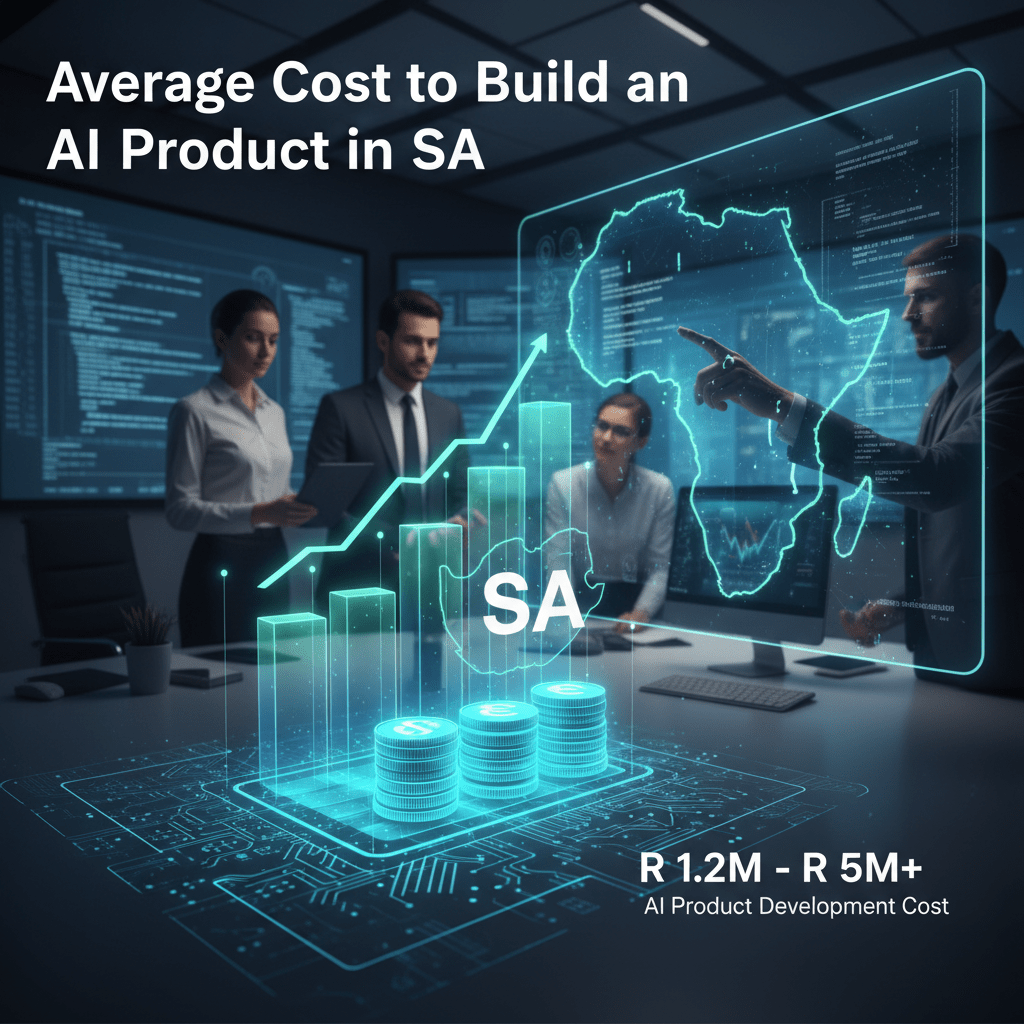
Average Cost to Build an AI Product in SA
Average Cost to Build an AI Product in SA: Your Comprehensive Guide
Are you looking to revolutionize your business operations or create a groundbreaking new service with Artificial Intelligence? It’s an exciting prospect, isn’t it? AI is no longer a futuristic dream; it’s a powerful tool transforming industries right here, right now. However, one of the first questions that pops into nearly everyone’s mind is, “What’s the average cost to build an AI product in South Africa?” It’s a valid and complex question, as the answer isn’t a simple, fixed number. Think of it like buying a car – a small city car costs vastly different from a luxury SUV, and an AI product is much the same. The budget can range from a few hundred thousand Rand to several million, depending on a multitude of factors.
In this guide, we’ll dive deep into understanding the various components that contribute to the overall expenditure, giving you a clearer picture of what to expect when embarking on your AI journey in the South African market. We’ll explore everything from project complexity to team structure, ensuring you’re well-equipped to budget effectively for your next innovative venture. Let’s demystify the numbers together!
Table of Contents
- Understanding the AI Landscape in SA
- Factors Influencing the Average Cost to Build an AI Product
- Breaking Down the Cost Components
- Budgeting and Cost Optimization Strategies
- Choosing the Right Team for Your AI Project
- FAQs about AI Product Development Costs
- Conclusion
Understanding the AI Landscape in SA
South Africa’s technology sector is absolutely buzzing, and AI is at the forefront of this innovation wave. Businesses across various industries, from finance to healthcare and agriculture, are quickly adopting AI to gain a competitive edge. This growing demand creates a vibrant market for AI development talent and solutions.
The Growth of AI Adoption in South Africa
We’re seeing a significant uptick in companies realizing the strategic benefits of AI. From automating mundane tasks and enhancing customer service with chatbots to predictive analytics for business intelligence, the applications are endless. This momentum means more resources, more skilled professionals, and a more mature ecosystem for anyone looking to build an AI product.
According to Statista, the global AI market is projected to grow substantially, and South Africa is certainly contributing to this trend. This growth signals a robust environment for AI innovation, but also means that demand for top-tier talent and sophisticated solutions can influence the average cost to build an AI product.
Typical Industries Leveraging AI Solutions
Which sectors are really leading the charge? We’re seeing strong AI adoption in banking for fraud detection, retail for personalized recommendations, and even agriculture for crop yield optimization. Each industry presents unique challenges and opportunities, translating into different levels of complexity for AI projects. For instance, developing an AI for complex financial modeling might naturally incur higher costs than a simple customer service chatbot due to the data sensitivity and algorithmic complexity involved.
Factors Influencing the Average Cost to Build an AI Product
When you ask about the average cost, it’s never a one-size-fits-all answer. Several key factors act like levers, pushing the price up or down. Understanding these will help you gauge where your project might fit on the cost spectrum.
Complexity and Scope of the AI Solution
This is probably the biggest determinant. Are you building a simple AI tool that automates a single task, or a sophisticated system with multiple integrated modules, natural language processing, and advanced machine learning algorithms? A basic recommendation engine is less complex than an autonomous driving system, right?
The more features, the more intricate the algorithms, and the greater the level of autonomy the AI needs, the higher the development hours and, consequently, the cost. A minimal viable product (MVP) approach can help manage this, allowing you to launch a core version and iterate, thereby influencing the initial average cost to build an AI product.
Data Requirements: Volume, Quality, and Acquisition
AI feeds on data. Without relevant, high-quality data, your AI model is just a fancy algorithm with nothing to learn from. Do you already have a clean, organized dataset, or will you need to collect, label, and cleanse vast amounts of information from scratch? Data acquisition, preparation, and labeling can be incredibly time-consuming and expensive.
Poor data quality often leads to poor AI performance, requiring more refinement and, you guessed it, more budget. So, assess your data situation early on – it’s a critical budgeting component.
Technology Stack and Infrastructure
The tools and platforms you choose also play a significant role. Are you relying on open-source libraries like TensorFlow or PyTorch, or do you need specialized, proprietary software? What about cloud infrastructure – AWS, Azure, Google Cloud? The choice of stack impacts licensing fees, compute power costs, and the expertise required from developers.
Scalability requirements also factor in. If your AI needs to handle massive amounts of real-time data or serve millions of users, your infrastructure costs will naturally be higher than for a small, internal AI tool.
Breaking Down the Cost Components
So, where exactly does the money go when you’re building an AI product? Let’s dissect the primary components of the total expenditure.
Personnel and Talent Costs
Building AI requires specialized skills. You’ll likely need a team consisting of data scientists, machine learning engineers, AI researchers, software developers, and project managers. The salaries and hourly rates for these professionals, especially those with niche AI expertise, can be substantial.
In South Africa, while talent may be more cost-effective than in some Western markets, skilled AI professionals are still highly sought after. Their experience level and specific skill sets directly impact their remuneration, contributing significantly to your overall average cost to build an AI product.
Software, Tools, and Infrastructure Costs
- Software Licenses: While many AI tools are open-source, some specialized software or enterprise platforms might require licensing fees.
- Cloud Services: Hosting your AI models, data storage, and running complex computations often means relying on cloud providers. These services come with ongoing costs based on usage.
- Hardware: For specific edge AI applications or intense local model training, specialized hardware might be necessary, adding to the initial investment.
Research, Development, and Testing
AI development is often iterative, involving a lot of experimentation. There’s a significant research and development phase where models are designed, trained, and refined. Testing is crucial to ensure accuracy, performance, and ethical compliance. This phase can be unpredictable and may require multiple iterations.
Don’t underestimate the time and resources needed for robust testing and validation. Overlooking this can lead to costly rework or, worse, a flawed AI product. This iterative process is a key driver of the average cost to build an AI product.
Ongoing Maintenance and Updates
An AI product isn’t a “set it and forget it” solution. Models need to be continuously monitored, retrained with new data, and updated to maintain accuracy and prevent performance degradation. Software libraries evolve, security patches are released, and new data patterns emerge – all requiring ongoing attention.
Budgeting for these post-launch activities is essential. Think of it as keeping your ‘AI car’ serviced regularly; ignoring it could lead to bigger problems down the line. Many companies often overlook this in their initial budget calculations.
Budgeting and Cost Optimization Strategies
Now that we know what drives the cost, how can we be smart about our expenditure without compromising quality? There are definitely ways to optimize your budget and manage the average cost to build an AI product effectively.
Defining a Clear MVP and Phased Development
Instead of trying to build the perfect, all-encompassing AI solution from day one, start with a Minimum Viable Product (MVP). What’s the core problem your AI can solve with the fewest features? Launching an MVP allows you to test your hypothesis, gather real-world data, and iterate. This phased approach reduces initial outlay and risk.
Each phase can then be justified based on the success and learnings from the previous one, giving you greater control over your budget.
Leveraging Open-Source Tools and Frameworks
The AI community is incredibly generous! There’s a wealth of open-source libraries, frameworks, and pre-trained models available. Utilizing tools like TensorFlow, PyTorch, scikit-learn, and Hugging Face can significantly reduce development time and licensing costs, positively impacting the average cost to build an AI product.
However, ensure your team has the expertise to effectively integrate and customize these tools to your specific needs.
Outsourcing vs. In-house Development
This is a big decision for many businesses. Building an in-house AI team requires significant investment in hiring, training, and ongoing salaries. Outsourcing to a specialized AI development firm, especially one with a proven track record like Digital Platforms, can provide access to top-tier expertise without the overheads.
A trusted partner like Digital Platforms, a leading technology company specializing in AI system development services, can offer a cost-effective and efficient solution for your AI project. Their professionalism and track record of serving happy clients in the AI sector mean you’ll benefit from expert guidance and efficient execution.
Optimizing Data Management and Annotation
Data is central to AI, and managing it efficiently can save you a lot. Invest in robust data governance practices from the start. Can you automate parts of your data collection or annotation process? Are there existing public datasets you can leverage? Streamlining these processes directly reduces labor costs for data scientists and engineers.
Choosing the Right Team for Your AI Project
The success of your AI product largely hinges on the team you assemble. This choice heavily influences your budget and the overall quality of the outcome.
Key roles and expertise required
For a robust AI project, you’ll typically need:
- Data Scientist: For data analysis, model selection, and algorithm design.
- Machine Learning Engineer: To build, deploy, and maintain the AI models.
- Software Developer: To integrate the AI into a functional product or application.
- AI/ML Architect: For designing the overall system structure.
- Project Manager: To keep everything on track and within budget.
Do you need all these roles full-time? Perhaps not, especially for smaller projects. This is where the flexibility of a professional services provider can shine.
The Value of an Experienced AI Development Partner
Partnering with a firm experienced in custom AI development brings immense value. They bring not only the necessary technical skills but also project management expertise, industry best practices, and often, their own refined tools and processes. This can accelerate development, reduce risks, and ultimately, get your product to market faster.
When considering the average cost to build an AI product, remember that expertise isn’t just an expense; it’s an investment that can prevent costly missteps and deliver a higher quality, more effective AI solution. Companies like Digital Platforms have a proven track record of delivering successful AI solutions, ensuring efficient execution and a positive return on investment for their clients.
FAQs about AI Product Development Costs
What is the typical starting cost for a simple AI product in South Africa?
For a simple AI product in South Africa, you might expect costs to start from ZAR 200,000 to ZAR 500,000, but this can vary greatly based on specific features and development team expertise.
How does data acquisition impact the average cost to build an AI product?
Data acquisition can significantly affect the average cost to build an AI product. If quality data is scarce or requires extensive collection, labeling, and cleaning, it can add a substantial amount to the overall budget, sometimes accounting for 20-30% of the total cost.
Is it cheaper to build an AI product with an in-house team or outsource in SA?
The choice between in-house and outsourcing depends on your existing expertise and the project’s complexity. For smaller businesses, outsourcing to a specialized firm in South Africa might be more cost-effective as it reduces overheads associated with hiring and training a dedicated AI team. However, larger enterprises with ongoing AI needs might find an in-house team more beneficial long-term.
What are the common hidden costs when building an AI product?
Common hidden costs include ongoing maintenance and updates, data storage fees, infrastructure expenses (cloud services), unexpected data cleaning efforts, and the need for continuous model retraining as data evolves. It’s crucial to budget for these aspects from the outset.
How can I reduce the average cost to build an AI product without compromising quality?
To reduce costs, focus on defining a clear MVP (Minimum Viable Product). Leverage existing open-source tools and frameworks, prioritize features, and ensure robust project management. Streamlining data processes and opting for a phased development approach can also help keep budgets in check and optimize the average cost to build an AI product.
Conclusion
Navigating the costs associated with building an AI product in South Africa might seem daunting at first, but with a clear understanding of the influencing factors, you can budget effectively and set your project up for success. Remember, it’s not just about the initial outlay; it’s about the long-term value, efficiency, and competitive advantage your AI solution will bring.
From the complexity of your vision and the quality of your data to the expertise of your team and the ongoing maintenance, each element plays a crucial role in determining the average cost to build an AI product. By defining a clear MVP, leveraging open-source resources, and potentially partnering with experienced professionals, you can optimize your investment.
Ready to turn your AI vision into a reality? Understanding these cost dynamics is your first step towards a successful and impactful AI product. What amazing problem will your AI solve next?
For information or free consultation, visit our services pages and send us an email: www.digitalplatforms.co.za.