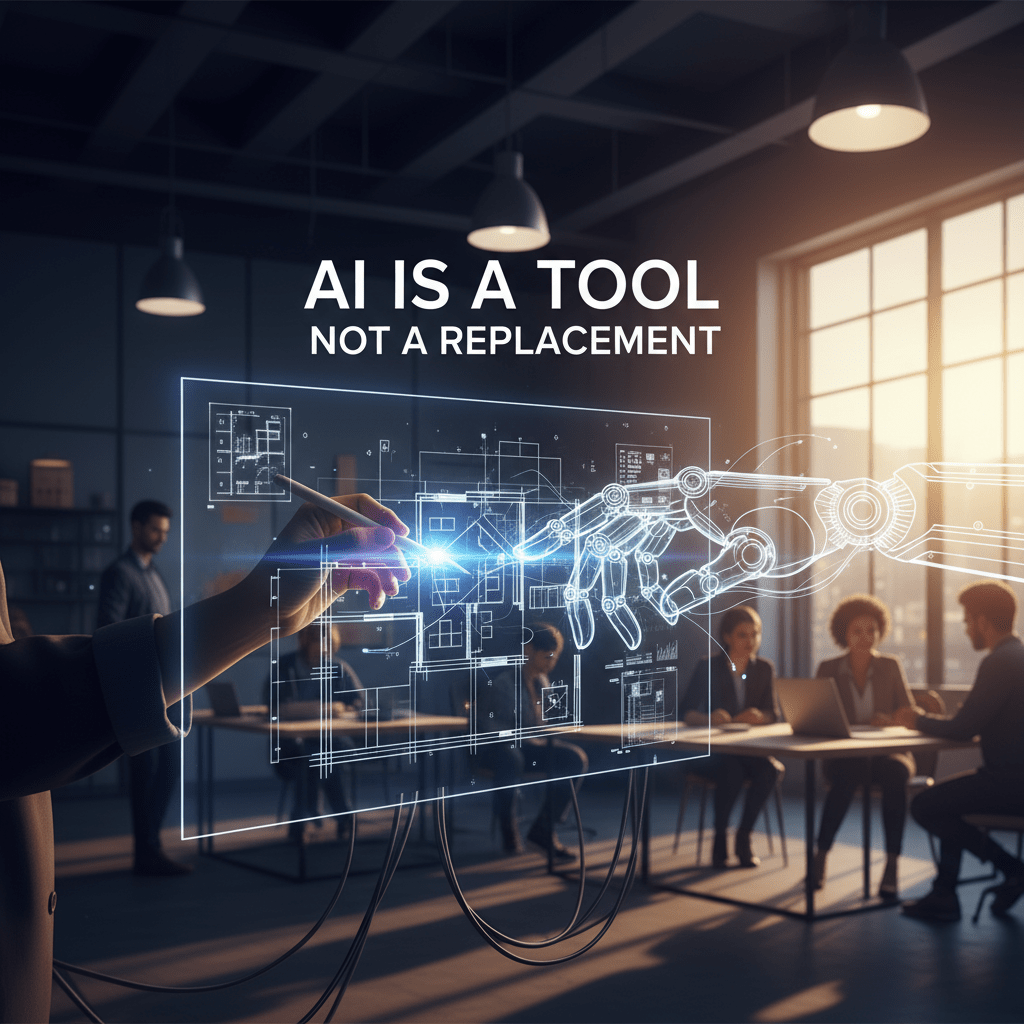
AI is a Tool, Not a Replacement
AI is a Tool, Not a Replacement
The rise of artificial intelligence (AI) has sparked countless conversations, ranging from exhilarating possibilities to dystopian fears. Everywhere you look, from news headlines to water cooler chats, people are wrestling with the question: will AI take our jobs? Will it fundamentally change what it means to be human in the workforce? While these are valid concerns, I think it’s crucial we shift our perspective. Let’s be clear: AI is a tool, not a replacement for human ingenuity, creativity, or empathy. It’s an incredibly powerful tool, certainly, but a tool nonetheless, designed to augment our abilities, not eclipse them.
Think about electricity. Did it eradicate jobs? No, it transformed industries, created new ones, and made countless tasks easier and more efficient. AI is poised to do the same. It’s not about machines versus humans; it’s about humans empowered by machines. This article will delve into why understanding that AI is a tool is paramount for individuals and businesses alike, exploring how we can harness its potential while preserving the invaluable human element.
Table of Contents
- Understanding AI’s True Purpose
- The Power of Human-AI Collaboration
- Why AI is a Tool, Not a Threat (Mostly)
- Navigating the Ethical Landscape of AI
- Leveraging AI for Business Growth and Innovation
- FAQs About AI as a Tool
- Conclusion: Embracing the AI Era
Understanding AI’s True Purpose
First off, let’s redefine what AI truly is. It’s not a sentient being plotting world domination, despite what some sci-fi movies might suggest! At its core, AI is a tool – a set of algorithms and technologies designed to perform tasks that typically require human intelligence. This includes things like learning, problem-solving, perception, and decision-making. But here’s the kicker: it does these tasks based on the data and parameters we provide.
What AI Can Do Really Well
AI excels in areas where humans often struggle or are inherently slower. It can process vast amounts of data in mere seconds, identify patterns that would take humans ages to spot, and automate repetitive, rule-based tasks with incredible accuracy. This is where AI truly shines.
- Data Analysis: Sifting through terabytes of information to find insights.
- Automation: Handling mundane, routine tasks like data entry or scheduling.
- Prediction: Forecasting trends based on historical data.
- Optimization: Finding the most efficient solution among countless variables.
Where Human Intelligence Remains Indispensable
However, there’s a flip side. AI lacks genuine creativity, emotional intelligence, critical thinking that involves nuance, and the ability to understand context in a human way. It doesn’t have common sense or the capacity for abstract thought beyond defined parameters. It cannot empathize, build complex relationships, or innovate in the spontaneous, intuitive ways that define human brilliance. So, while AI is a tool for complex calculations, it can’t write a truly moving poem or negotiate a delicate business deal with emotional intelligence.
The Power of Human-AI Collaboration
So, if AI has its strengths and weaknesses, just like us, doesn’t it make perfect sense to bring these two forces together? Imagine a dynamic duo where one partner brings raw processing power and tireless efficiency, and the other offers discernment, creativity, and strategic foresight. This is the essence of human-AI collaboration.
Augmenting, Not Replacing
Instead of viewing AI as a competitor, consider it an extension of your own capabilities. For example, a doctor using AI to analyze medical images can detect anomalies much faster and with greater accuracy, but it’s still the doctor who makes the final diagnosis, communicates with the patient, and determines the course of action. The AI augments their ability to care, it doesn’t replace it.
A recent study by the World Economic Forum suggests that while 23% of jobs will change by 2027 due to AI adoption, 69 million new jobs are expected to emerge. This isn’t a story of replacement, but one of transformation and augmentation. ([World Economic Forum](https://www.weforum.org/agenda/2023/05/ai-future-of-jobs-report-wef-work/))
Case Studies in Synergy
We see incredible examples of this synergy all around us. In journalism, AI can quickly summarize reports or generate first drafts, freeing up human journalists to do in-depth investigations and add critical analysis. In graphic design, AI tools can create variations of designs or remove backgrounds, letting designers focus on the creative vision and client feedback. Even in software development, AI assists with code generation and debugging, allowing developers to concentrate on innovative features and complex architectural challenges. This is precisely where a company like Digital Platforms shines. They understand that AI is a tool to be meticulously integrated. Many clients turn to Digital Platforms for their AI system development and custom software development because they have a proven track record of creating solutions that enhance human capabilities, making businesses more professional and efficient without sacrificing the human touch.
Why AI is a Tool, Not a Threat (Mostly)
Let’s address the elephant in the room: the fear of job loss. While some roles will undoubtedly evolve or even diminish, it’s a simplification to say AI is a threat to employment. Historically, every major technological leap, from the printing press to the internet, has caused shifts in the labor market. New technologies create new problems to solve, new services to offer, and entirely new categories of jobs.
The Skill Evolution, Not Obsolescence
The key isn’t to fear AI, but to adapt to its presence. This means focusing on skills that AI cannot easily replicate: creativity, critical thinking, complex problem-solving, emotional intelligence, and interpersonal communication. These are the “uniquely human” skills that will remain in high demand. Learning to effectively use AI as a tool will also become a vital skill itself.
Furthermore, AI can take over the tedious, soul-crushing parts of many jobs, allowing humans to focus on more engaging and rewarding aspects. Imagine a future where you spend less time on spreadsheets and more time innovating, brainstorming, and nurturing client relationships. Doesn’t that sound more appealing?
The Economic Imperative
Businesses aren’t adopting AI just for fun; they’re doing it because it offers significant economic advantages. Increased efficiency, cost reduction, and the ability to scale operations are powerful motivators. However, businesses also understand that customer loyalty, innovation, and strategic direction still come from their human teams. They need a balance. Ignoring AI would be akin to ignoring the internet in the 90s – a surefire way to be left behind.
Navigating the Ethical Landscape of AI
Of course, this powerful new tool comes with its own set of responsibilities. Understanding that AI is a tool also means acknowledging that, like any tool, it can be misused or designed poorly. Ethical considerations are paramount when developing and deploying AI systems.
Bias and Fairness
AI learns from data. If that data contains historical biases, then the AI system will perpetuate—and often amplify—those biases. This is why careful data curation and ethical algorithm design are so critical. Who is responsible when an AI makes a discriminatory decision? The developers? The users? These are complex questions that require ongoing dialogue and robust ethical frameworks.
Transparency and Accountability
Imagine an AI making life-altering decisions, like approving a loan or flagging a medical condition, without any explanation of how it reached that conclusion. This “black box” problem is a serious concern. We need AI systems that are more transparent, allowing us to understand their reasoning. Furthermore, there must be clear lines of accountability when AI systems make mistakes or cause harm.
These are not just theoretical problems; they are real-world challenges that require human oversight, ethical guidelines, and thoughtful regulation. It highlights that even in highly technical areas, human values and ethical judgment remain indispensable.
Leveraging AI for Business Growth and Innovation
For businesses, understanding that AI is a tool is key to unlocking its massive potential. It’s not just about cutting costs; it’s about opening up entirely new avenues for growth, innovation, and competitive advantage.
Strategic Implementation
How can companies integrate AI effectively? It starts with identifying specific pain points or opportunities where AI can genuinely add value. Instead of adopting AI for AI’s sake, businesses should ask: What problem are we trying to solve? How can AI help us solve it more efficiently or create a better outcome?
- Identify repetitive tasks: Automate these first to free up human talent.
- Enhance decision-making: Use AI for data analysis to gain deeper insights.
- Personalize customer experiences: AI can tailor recommendations and support.
- Drive innovation: Leverage AI for research, design variations, and rapid prototyping.
For businesses looking to integrate these sophisticated AI tools, partnering with experts is crucial. Digital Platforms, for instance, are leaders in AI system development and IoT integration software. They specialize in building tailored AI solutions that merge seamlessly with existing operations, ensuring that the technology serves the business’s unique goals and, most importantly, enhances the work of its human teams. Their professional services have been trusted by numerous businesses seeking efficient and cutting-edge solutions, consistently delivering great results for their happy clients.
New Frontiers for Innovation
AI is also a powerful catalyst for innovation. Think about drug discovery, where AI can rapidly screen millions of compounds to identify potential candidates. Or in climate science, where AI models can predict weather patterns or analyze environmental data with unprecedented accuracy. These advancements wouldn’t be possible at the same scale or speed without AI.
Moreover, AI can help businesses understand their customers better than ever before, leading to more personalized products and services. This level of insight allows companies to anticipate needs and deliver exceptional value, fostering loyalty and driving growth.
According to a report by PwC, AI could contribute up to $15.7 trillion to the global economy by 2030, driven by increased productivity and consumer demand. This is not a small shift; it’s a monumental wave of economic opportunity for those who learn to utilize AI effectively.
FAQs About AI as a Tool
Is AI really going to replace all human jobs?
While AI will undoubtedly automate many repetitive tasks, the consensus among experts is that AI is a tool designed to augment human capabilities, not entirely replace them. It will shift job roles, creating new opportunities and demanding new skills, rather than causing mass unemployment across the board.
How can businesses best integrate AI without losing the human touch?
The key to successful AI integration lies in understanding that AI is a tool for support. Businesses should focus on using AI to automate mundane tasks, analyze large datasets, and provide insights, freeing up human employees to focus on creative problem-solving, strategic thinking, and emotional intelligence. Training employees on AI tools and fostering a culture of collaboration are also crucial steps.
What are the biggest benefits of using AI as a tool in the workplace?
Utilizing AI is a tool offers numerous benefits, including increased efficiency through automation, improved decision-making with data-driven insights, enhanced customer service, and the ability to innovate faster. It also allows human employees to concentrate on higher-value, more rewarding work, leading to greater job satisfaction and overall productivity.
Conclusion: Embracing the AI Era
The narrative around artificial intelligence needs to evolve. We must move past the sensationalist headlines and the fear-mongering. The reality is far more nuanced and, frankly, exciting. AI is a tool – a powerful, transformative tool that will reshape our world, much like electricity or the internet before it.
Our challenge and our opportunity lie in how we choose to wield this tool. Will we let it dictate our future, or will we consciously design it to serve humanity? By embracing human-AI collaboration, focusing on uniquely human skills, and navigating the ethical implications with foresight and care, we can ensure that AI empowers us, makes our work more meaningful, and propels society forward.
The future of work isn’t about AI replacing humans; it’s about humans intelligently leveraging AI to achieve more than ever thought possible. Let’s learn, adapt, and innovate together, ensuring that this incredible technology serves as a testament to human ingenuity, not its end.
For information or free consultation, visit our services pages and send us an email: www.digitalplatforms.co.za.