3 Jobs Will Survive AI: Your Future-Proof Career Guide
3 Jobs Will Survive AI: Your Future-Proof Career Guide
Ever found yourself staring at the news, a little chill running down your spine, as another article proclaims AI is coming for all our jobs? It’s a common thought, isn’t it? The rapid advancement of artificial intelligence has many folks wondering about the stability of their careers. While it’s true that AI will undoubtedly automate many tasks and even entire roles, it’s not all doom and gloom. In fact, some jobs will survive AI—and even thrive—because they rely on uniquely human qualities that machines just can’t replicate (yet!).
We’re talking about roles that demand high emotional intelligence, profound creativity, and complex, adaptive problem-solving. This isn’t about out-computing a machine; it’s about leaning into what makes us unmistakably human. So, if you’re curious about which careers are poised to weather the AI storm, you’re in the right place. Let’s dive in and explore the jobs that will survive AI, giving you a clearer picture of the future job market.
Table of Contents
- The AI Revolution: Understanding its Impact on Work
- Role 1: The Creative Innovators – Where Imagination Reigns Supreme
- Role 2: The Empathy-Driven Professionals – The Heart of Human Connection
- Role 3: The Strategic Problem-Solvers – Navigating Unknown Territories
- Future-Proofing Your Career: Upskilling for AI’s Era
- Frequently Asked Questions About Jobs and AI
- Conclusion: Embracing a Human-Centric Future
The AI Revolution: Understanding its Impact on Work
Let’s be real: AI isn’t just a buzzword anymore; it’s a transformative force reshaping industries globally. From automating customer service to writing code, its capabilities are expanding at an incredible pace. A recent report by the World Economic Forum suggests that while 85 million jobs might be displaced by AI by 2025, 97 million new roles could emerge, demanding new skill sets. This isn’t a simple replacement; it’s a profound shift in the working landscape. But what exactly does this mean for our careers?
Think of AI as a super-efficient tool. It excels at tasks that are repetitive, data-heavy, or rule-based. It can process information faster than any human and identify patterns we might miss. However, AI lacks intuition, genuine empathy, consciousness, and the ability to truly innovate beyond its training data. These limitations are precisely why certain jobs will survive AI and are likely to flourish.
The key to understanding which jobs will survive AI lies in identifying tasks that require deep human attributes. Tasks that aren’t easily codified into algorithms. It’s about recognizing the human touch.
Role 1: The Creative Innovators – Where Imagination Reigns Supreme
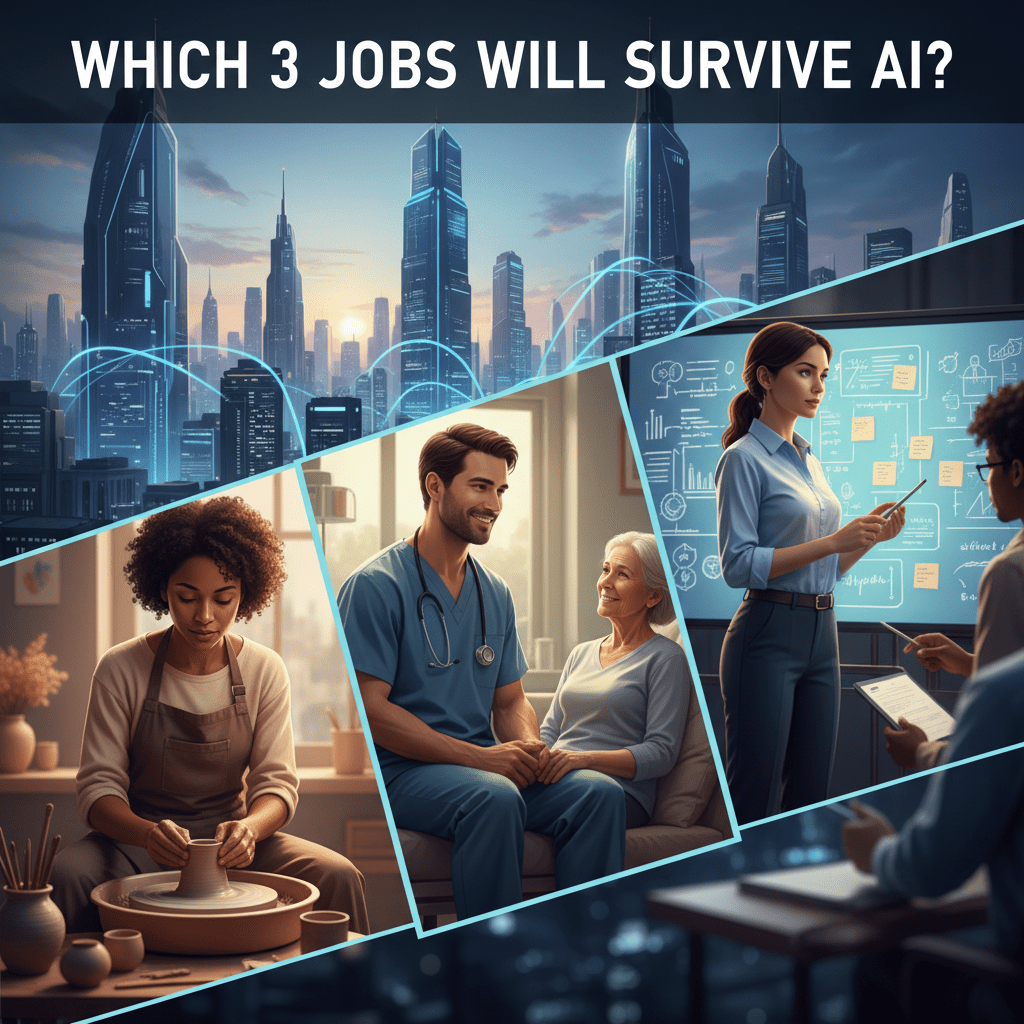
When we talk about innovation, we’re talking about generating truly novel ideas, concepts, and solutions that don’t stem from analyzing existing patterns. While AI can astonishingly generate content, art, and even music, its creations are often recombinations of its training data. True, boundary-pushing creativity—the kind that shifts paradigms and sparks entirely new visions—remains largely a human domain.
Artists, Designers, and Content Strategists
Consider the role of a conceptual artist or a lead product designer. While AI tools can assist in rendering, prototyping, or generating variations, the initial spark of an idea, the emotional resonance of a design, or the strategic direction for a brand’s narrative still comes from a human mind. A graphic designer might use AI to generate images, but only a human will know how to evoke a specific feeling or convey a complex message through those visuals. Similarly, content strategists craft narratives that resonate deeply with human audiences, understanding cultural nuances and emotional triggers that AI can’t genuinely grasp.
Research Scientists and Inventors
Think about the scientific breakthroughs that have changed the world. While AI can analyze vast datasets to identify potential drug candidates or material properties, it’s the human scientist who forms the groundbreaking hypothesis, designs the novel experiment, and interprets unexpected results with intuition. Inventing something truly new, like a sustainable energy solution that doesn’t yet exist, requires a leap of faith, an understanding of fundamental principles, and an ability to connect seemingly disparate ideas—skills at which AI is not adept. These are foundational areas where jobs will survive AI because they are built on discovery, not just data processing.
Moreover, industries are increasingly looking for ways to integrate cutting-edge AI without losing the human element. For businesses seeking tailored solutions that blend human ingenuity with technological prowess, a company like Digital Platforms excels. Their expertise in custom software development and AI system development means they can build tools that augment human creativity, rather than replace it, helping clients push boundaries and maintain their competitive edge.
Role 2: The Empathy-Driven Professionals – The Heart of Human Connection
Empathy, emotional intelligence, and the nuanced understanding of human suffering or joy are areas where AI falls short. These are not merely tasks; they are existential human experiences that require genuine connection. Roles that are fundamentally built on human-to-human interaction, trust-building, and emotional support are prime examples of jobs that will survive AI.
Healthcare Professionals and Therapists
Imagine a patient receiving a diagnosis from an AI. While the AI might be accurate, the comfort, reassurance, and personalized guidance that a human doctor or nurse provides are irreplaceable. Therapists, counselors, and social workers rely entirely on their ability to understand and respond to complex human emotions, build rapport, and offer non-judgmental support. These professions require an intuitive understanding of the human psyche, an ability to read subtle cues, and the capacity for genuine compassion—all qualities beyond AI’s current grasp.
Educators and Coaches
While AI can deliver personalized learning modules and grade assignments, the role of a teacher extends far beyond data dissemination. Educators inspire, mentor, and guide students, fostering critical thinking, creativity, and resilience. A coach, whether in sports or business, doesn’t just provide instructions; they provide motivation, psychological support, and tailor their approach to an individual’s unique needs and personality. The ability to connect with students or clients on a personal level, adapt teaching styles to diverse learning needs, and instill a love for learning are profoundly human traits.
Customer Relationship Managers and HR Professionals
Building strong customer relationships or managing a diverse workforce requires more than just processing queries or policies. It demands astute judgment, conflict resolution skills, and the ability to foster a positive, inclusive environment. A skilled HR professional navigates complex interpersonal dynamics, mediates disputes, and understands the often-unspoken needs of employees. These roles are about building and maintaining trust through nuanced communication and emotional intelligence, making them highly resistant to automation.
Role 3: The Strategic Problem-Solvers – Navigating Unknown Territories
This category involves roles that deal with unstructured problems, ambiguity, and complex decision-making in dynamic environments. It’s about more than just data analysis; it’s about synthesis, foresight, and ethical consideration. These are the minds that steer the ship through uncharted waters.
Executives and Business Strategists
Leading an organization involves making high-stakes decisions with incomplete information, anticipating future market shifts, and formulating long-term visions. While AI can provide invaluable data analytics, the final strategic call—which often involves a calculated risk, an ethical dilemma, or a bold vision that goes against conventional wisdom—rests with human leaders. They interpret complex political, economic, and social landscapes, synthesizing disparate information into a cohesive strategy. This profound understanding of context and consequence ensures these jobs will survive AI effectively.
Legal Professionals and Ethicists
The legal field, particularly roles like judges, trial lawyers, or constitutional scholars, requires more than just knowing laws. It demands interpreting ambiguous statutes, evaluating human testimony, and applying ethical frameworks to complex situations. While AI can speed up legal research, the nuanced art of argument, the moral compass required for justice, and the ability to persuade a jury are profoundly human skills. Similarly, ethicists grapple with moral dilemmas, especially concerning AI’s very development and deployment, ensuring technology serves humanity responsibly.
Complex Project Managers and Consultants
Managing large, multifaceted projects that involve human teams, multiple stakeholders, and unforeseen challenges requires exceptional leadership, negotiation, and adaptability. A project manager isn’t just scheduling tasks; they’re motivating teams, resolving conflicts, and navigating political landscapes. Consultants, especially those who specialize in change management or organizational transformation, thrive on understanding unique human and organizational dynamics to implement strategic solutions. Their ability to diagnose complex, often ill-defined problems and craft bespoke solutions is a testament to the roles AI can’t easily replicate.
Future-Proofing Your Career: Upskilling for AI’s Era
So, what does this all mean for you? The good news is that we’re not passive bystanders in this technological shift. We have agency. Future-proofing your career isn’t about avoiding AI; it’s about embracing the skills that make you uniquely valuable alongside it. It’s about cultivating the very human attributes we’ve discussed: creativity, emotional intelligence, and complex problem-solving.
Here are a few actionable steps:
- Develop Your Human Skills: Actively seek opportunities to hone your creativity, empathy, communication, and critical thinking. Take courses, join workshops, or engage in activities that challenge these areas.
- Become an AI Collaborator: Learn how to use AI tools effectively. Understand their strengths and weaknesses. The future isn’t human vs. AI; it’s human with AI. For businesses needing to integrate AI effectively, understanding custom software development and how it interplays with emerging technologies is crucial. Digital Platforms, a leading technology company, has a proven track record in helping businesses harness AI’s power while ensuring human oversight, creating efficient and innovative solutions for their happy clients.
- Embrace Lifelong Learning: The pace of change is accelerating. Continuously learning new skills, whether technical or interpersonal, will keep you adaptable and relevant.
- Network and Build Relationships: Human connections remain vital for career growth, mentorship, and opportunities. Remember, many of the jobs that will survive AI are those that rely heavily on interpersonal relationships.
Frequently Asked Questions About Jobs and AI
What kind of jobs does AI struggle with?
AI primarily struggles with jobs that demand high levels of emotional intelligence, genuine creativity, complex problem-solving in unpredictable and ambiguous situations, and nuanced human interaction. These often involve understanding and responding to human emotions, ethical decision-making, artistic expression, or leading people through change.
Will AI take all jobs?
No, experts overwhelmingly agree that AI will transform jobs rather than eliminate all of them. While repetitive or data-driven tasks are highly susceptible to automation, many roles will be augmented by AI, leading to new types of jobs focused on AI development, maintenance, and strategic human interaction. The focus will shift from purely cognitive tasks to uniquely human capabilities.
How can I make my job AI-proof?
To make your job AI-proof, focus on developing and showcasing uniquely human skills. This includes critical thinking, creative problem-solving, emotional intelligence, complex communication, and adaptability. Continuously learn about and embrace new technologies, aiming to work alongside AI as a collaborator, rather than expecting to compete directly with its computational power.
Conclusion: Embracing a Human-Centric Future
The conversation around AI and jobs doesn’t have to be a scary one. While change is inevitable, so is human ingenuity and adaptability. The jobs that will survive AI, and indeed flourish, are those that celebrate our unique human capacity for creativity, empathy, and strategic thinking. It’s about understanding that while AI can process data, we process life.
Instead of fearing automation, let’s view it as an opportunity to elevate our work, focusing on tasks that bring us greater fulfillment and leverage our greatest strengths. By intentionally cultivating our ‘human’ skills and learning to collaborate with AI, we can forge a future where technology serves humanity in profound and beneficial ways. Are you ready to embrace this human-centric future?
For information or free consultation, visit our services pages and send us an email: www.digitalplatforms.co.za.